

27 Feb What Is the Best Basement Layout to Add More Usable Space in Bloomington Idaho
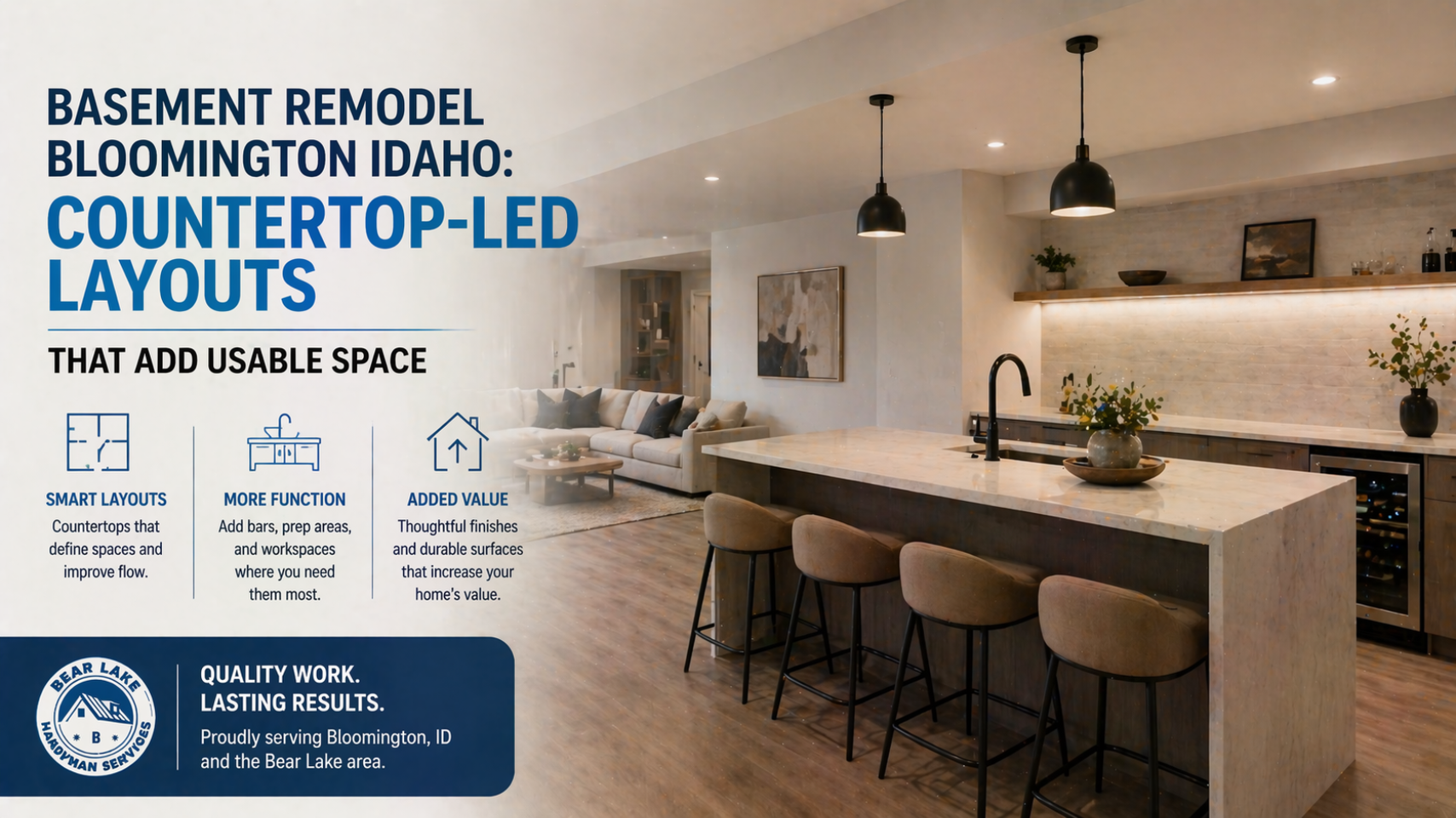
Basement Remodel Bloomington Idaho: Countertop-Led Layouts That Add Usable Space
A basement remodel Bloomington Idaho project is not about adding square footage.
It is about improving how each square foot functions.
In Bloomington homes, basements typically serve as:
- Secondary living areas
- Guest overflow space
- Recreation zones
- Storage corridors
- Mechanical access areas
Because many Bloomington basements measure between 900–1,100 square feet with ceiling heights around 7–8 feet, layout efficiency matters more than decorative trends.
One of the most underutilized layout tools is countertop placement.
When designed correctly, basement countertops Bloomington Idaho homeowners install can define zones without framing walls, preserve traffic flow, and improve long-term resale flexibility.
Structural Realities in a Basement Remodel Bloomington Idaho Project
Before layout decisions are made, these structural factors must be addressed:
- Concrete slab subfloors (often uneven by ¼”–½” across 15–20 feet in older homes)
- HVAC bulkheads reducing head clearance
- Stair landing compression points
- Limited natural light
- Load-bearing walls intersecting basement stairs
Countertop-led zoning only works if cabinetry is fully leveled and anchored before templating.
Ignoring slab variance can cause seam stress and overhang deflection over time.
Countertop Zoning Framework for Smaller Bloomington Basements
Basement Remodel Bloomington Idaho – Countertop Zoning Standards
This zoning method improves usability without reducing open space.
How Much Does a Basement Remodel in Bloomington Idaho Cost?
Homeowners searching for basement remodels in Bloomington, Idaho, are typically looking for budget clarity.
Typical Project Ranges
Basement Remodel Cost Ranges (Bloomington, Idaho)
Primary Bloomington cost drivers include:
- Electrical relocation for zoning
- Concrete leveling
- Steel bracket reinforcement for basement bar countertops Idaho
- HVAC rerouting
Countertop-led zoning can reduce framing labor costs while increasing functional flexibility.
How Countertops Define Zones in Smaller Bloomington Basements
In many custom basement remodel Bloomington projects, we use surfaces to define three primary functional zones.
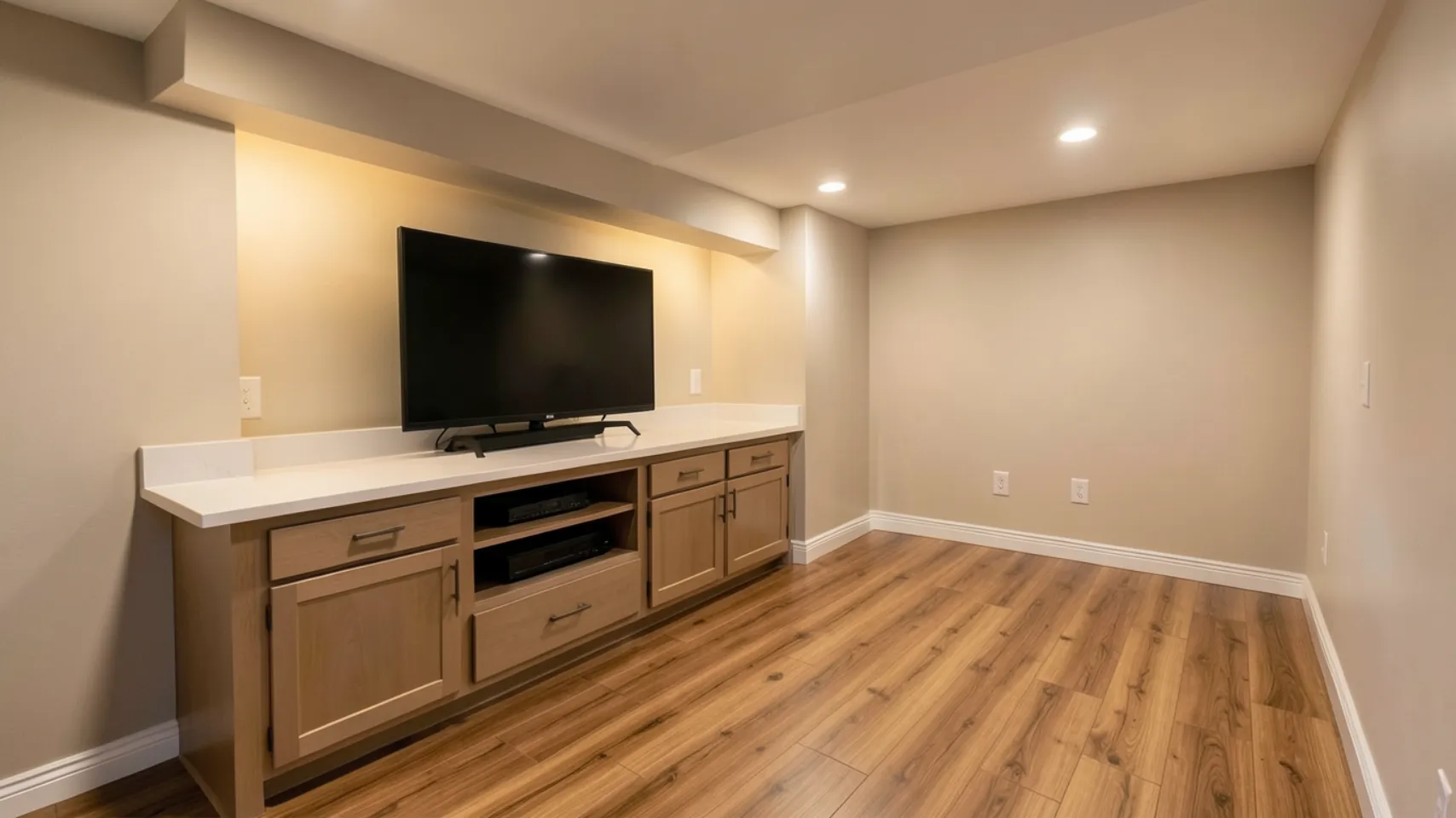
1. Bar Zone (Entertainment Anchor)
Basement bar countertops Idaho homeowners install typically function as:
- Serving surface
- Seating overhang
- Beverage prep area
- Visual anchor
Clearance standards to follow:
- Minimum 36” behind seated bar area
- 42” preferred if traffic passes behind seating
- 10–12” maximum unsupported overhang (requires steel support beyond that)
In Bloomington basements under 900 square feet, bar placement often works best against a load-bearing wall to preserve central movement space.
2. Utility Counter Zone
In Bloomington homes, basements often include:
- Mechanical rooms
- Laundry spaces
- Storage corridors
Adding a continuous countertop above utility cabinetry:
- Creates folding surface
- Adds tool workspace
- Improves organization
- Defines mechanical area boundaries
Recommended material approach:
Avoid dark or heavily veined surfaces in mechanical corridors.
3. Storage & Display Surface Zone
Rather than adding bulky cabinetry, custom basement remodel Bloomington layouts can extend countertops over:
- Built-in cubbies
- Media units
- Bench seating
- Window wells
This creates horizontal breathing space without visual crowding.
In smaller Bloomington basements, restraint improves perceived square footage.
Countertop Placement Strategy in a Custom Basement Remodel Bloomington
Effective countertop-led design follows structural logic.
Structural Placement Checklist
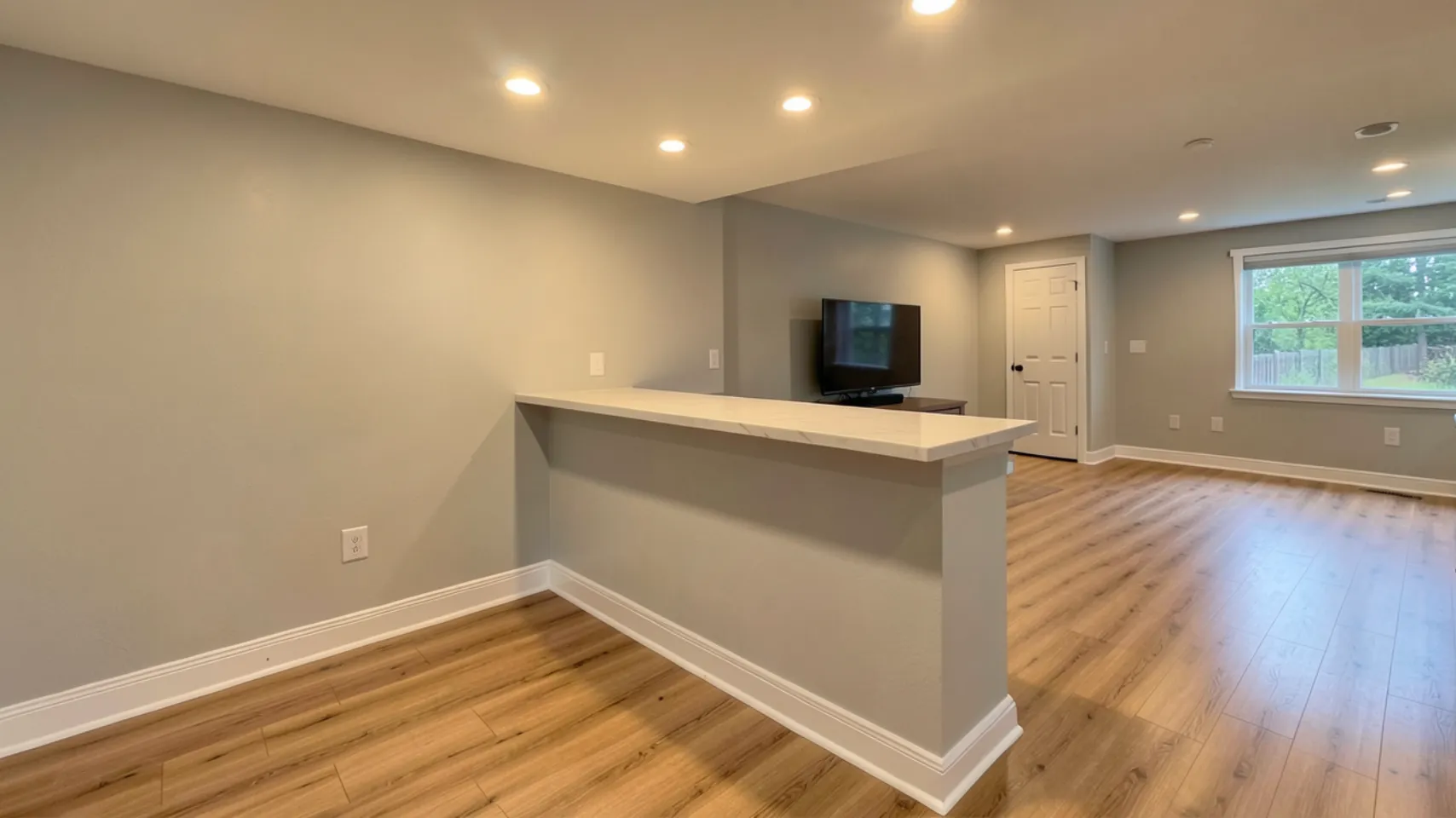
Poor placement leads to:
- Awkward transitions
- Shadow-heavy corners
- Unusable walkways
- Overbuilt appearance
Layout efficiency determines long-term usability more than material cost.
Our Countertop-Led Basement Remodel Process in Bloomington Idaho
Every custom basement remodel Bloomington project follows a structured process:
Step 1 – Functional Zoning Review
We measure:
- Ceiling height
- Traffic flow
- Stair landing clearance
- Existing mechanical access
Step 2 – Countertop Placement Mapping
We determine:
- Where surfaces define zones
- Which spans require reinforcement
- Seam positioning over cabinet support
Step 3 – Structural Verification
We confirm:
- Subfloor level variance
- Wall anchoring points
- Overhang bracket placement
Step 4 – Finish Coordination
We align:
- Flooring undertone
- Quartz movement
- Lighting temperature
- Hardware finish
This method prevents:
- Deflection
- Visual compression
- Traffic bottlenecks
- Overbuilt framing
This is how a basement remodel Bloomington Idaho project transitions from concept to durable execution.
Choosing Basement Countertops Bloomington Idaho Homeowners Should Prioritize in 2026
In 2026, finish direction continues to favor natural inspiration, subtle movement, and coordinated restraint.
However, in a basement remodel Bloomington Idaho project, trend adoption must be adapted — not copied from kitchens.
Recommended characteristics:
1. Lighter Quartz With Soft Movement
Swirling fog-white and muted earth-toned quartz provide brightness without overpowering compact layouts.
2. Controlled Veining
Aggressive contrast patterns can dominate low-light basements. Subtle movement preserves openness.
3. Appropriate Thickness (2cm vs 3cm)
- 2cm quartz works well for utility and display surfaces where span is supported.
- 3cm is recommended for basement bar countertops Idaho installations with 10–12 inch overhangs.
4. Coordinated Hardware Finishes
Gold and warm metal tones remain strong, but in basements they should be repeated sparingly — bar faucet, cabinet pull, and light fixture only, to avoid over-layering.
5. Finish Restraint for Resale
Custom basement remodel Bloomington projects should maintain continuity with upper floors. Dramatic statement surfaces may narrow buyer appeal.
Countertop selection in Bloomington basements should support layout efficiency first and trend alignment second.
How Flooring Tone Influences Countertop Selection in a Basement Remodel Bloomington Idaho
In a basement remodel Bloomington Idaho project, flooring and countertop coordination must account for reduced natural light.
Bloomington basements often feature:
- Concrete subfloors
- Lower ceiling heights
- Limited window exposure
When warm honey oak or earth-toned flooring is installed, countertop selection must avoid cool-gray undertones that create visual imbalance.
For example:
- Warm flooring + cool blue-gray quartz = compressed visual feel
- Warm flooring + soft fog-white quartz = expanded perception
In lower-light basements, lighter quartz tones reflect artificial lighting more evenly, increasing perceived square footage. Countertop color is not simply aesthetic, it affects spatial perception.
Edge Profile Selection: Why Simpler Is Stronger in Bloomington Basements
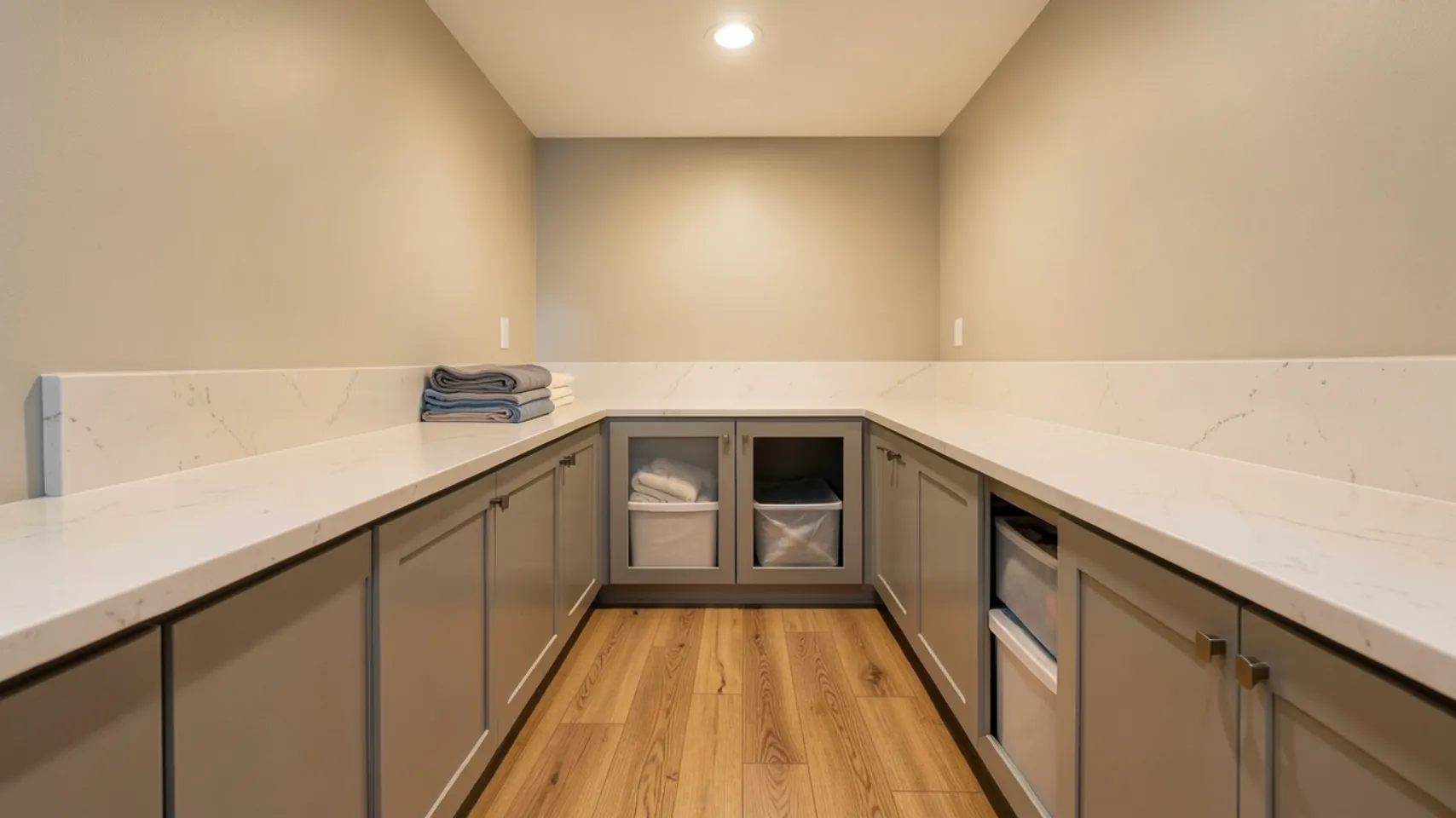
Heavy edge profiles may work in large kitchens, but in a custom basement remodel Bloomington project, restraint improves usability.
Basement-friendly edge profiles include:
- Eased edge
- Pencil edge
- Subtle bevel
Avoid:
- Ogee
- Layered decorative edges
- Overly thick laminated profiles
Thicker visual edges create unnecessary visual weight in compact basement layouts.
Minimal edge detailing supports:
- Cleaner sight lines
- Modern resale positioning
- Easier long-term maintenance
Edge restraint aligns with current finish direction while maintaining layout clarity.
Lighting Temperature and Surface Interaction in Basement Countertops Bloomington Idaho
Artificial lighting plays a larger role in basement remodel Bloomington Idaho projects than in upper-floor remodels.
Recommended temperature range:
3000K–3500K (warm white)
Cooler LED lighting (4000K+) can:
- Flatten quartz movement
- Emphasize seams
- Create harsh shadowing on bar overhangs
Lighter quartz tones combined with warm lighting enhance:
- Depth perception
- Surface texture
- Visual comfort
Countertops should be selected with final lighting temperature in mind, not showroom lighting conditions.
Basement Bar Countertops Idaho: Structural Considerations
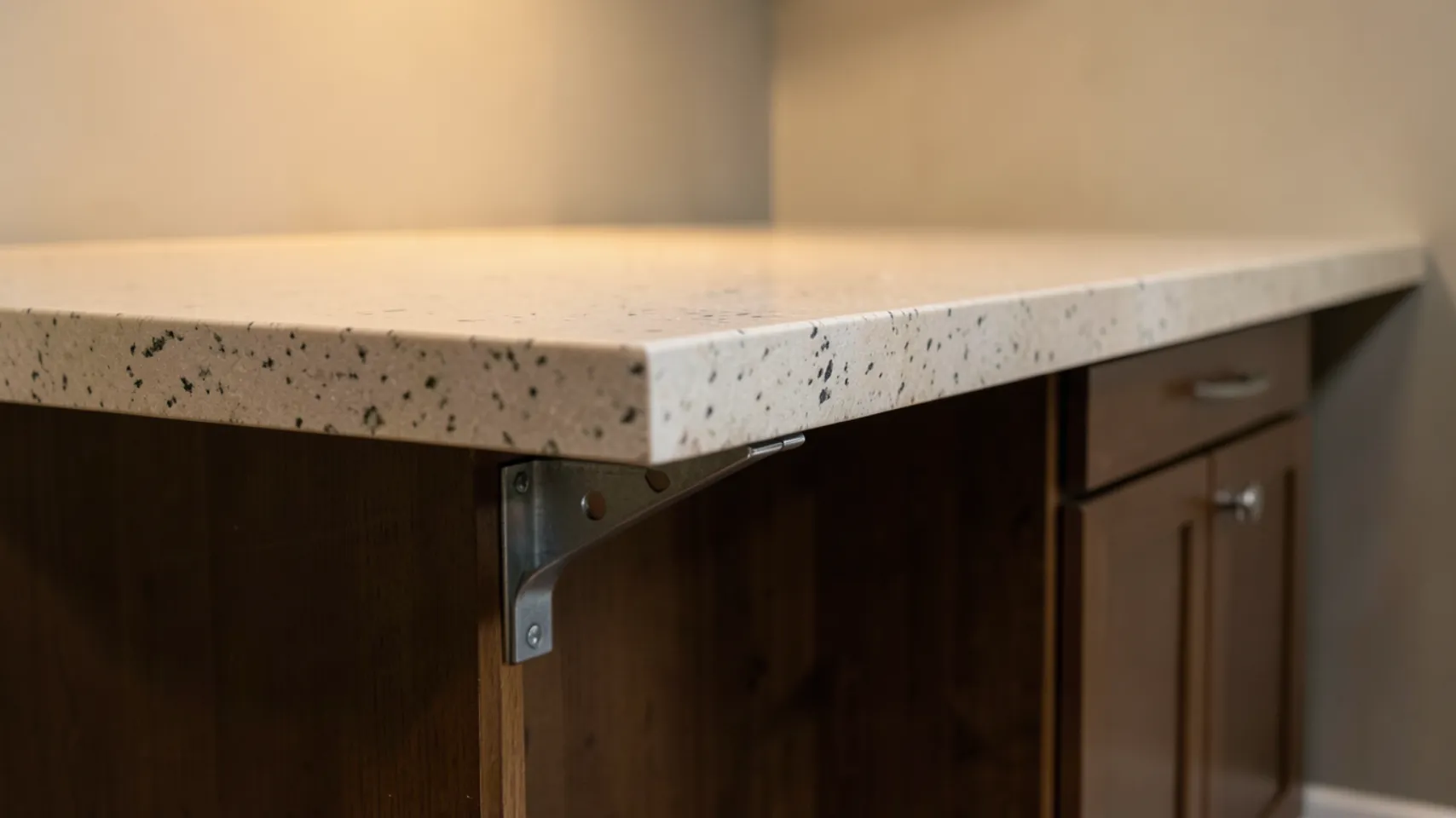
Bar overhangs in basements often exceed 10–12 inches.
Proper reinforcement requires:
- Steel bracket support
- Cabinet rail reinforcement
- Plywood substrate beneath stone
- Seam positioning over load points
Ignoring reinforcement leads to deflection over time. In Bloomington’s older homes, floor-level variance must also be corrected before templating. Sequencing still matters, even outside the kitchen.
Avoiding Overbuilding in a Basement Remodel Bloomington Idaho
One of the most common mistakes in custom basement remodel Bloomington projects is over-design.
Examples include:
- Dark stone in low-light areas
- Heavy edge profiles
- Excessive mixed finishes
- Overly thick countertops
- Aggressive veining patterns
Basement resale performance improves when finishes are:
- Neutral
- Coordinated
- Consistent with upper-floor design language
Countertops should define space, not dominate it.
Real-World Example: Countertop-Led Layout in a Bloomington Basement
In a recent basement remodel Bloomington Idaho project near Main Street, the homeowner originally planned to frame a half-wall to separate a media area from a bar.
The Bloomington property had:
- 7’6” ceiling clearance
- Slight ⅜” floor variance across 18 feet
- Existing HVAC bulkhead along north wall
By anchoring the countertop along the structural wall and leveling cabinetry before templating, we avoided seam stress and preserved a 38” traffic path between zones.
Instead, we extended a continuous quartz countertop across:
- A built-in media console
- A recessed bar cabinet
- A narrow storage niche
This eliminated the need for framing, preserved open sight lines, and created a unified zone without reducing usable floor area.
The result:
- Improved traffic flow
- Increased perceived square footage
- Cleaner resale profile
- Reduced framing costs
Countertop placement replaced unnecessary construction.
How Countertop-Led Design Supports Long-Term Remodel Value
In a basement remodel Bloomington Idaho project, value is defined by:
- Usability
- Adaptability
- Layout efficiency
- Structural integrity
When basement countertops Bloomington Idaho homeowners install are:
- Strategically placed
- Structurally reinforced
- Visually restrained
- Properly sequenced
They improve both daily function and resale flexibility.
Basement Remodel Bloomington Idaho: Usable Space Is Designed, Not Added
Square footage does not change. Function does.
A custom basement remodel Bloomington approach that uses countertops as layout anchors creates:
- Defined zones
- Improved organization
- Balanced lighting
- Structural stability
- Strong resale positioning
Basement bar countertops Idaho installations, utility surfaces, and display counters should always serve layout efficiency first and finish style second. That is how smaller basements feel larger.
Frequently Asked Questions: Basement Remodel Bloomington Idaho
What is the most practical countertop material for a Bloomington basement remodel?
Quartz is typically the most durable and resale-safe choice due to structural strength and low maintenance.
How deep should a basement bar countertop be?
24–30 inches is standard, with reinforcement required for overhangs exceeding 10–12 inches.
Does a basement countertop need steel brackets?
Yes, if overhang exceeds 10–12 inches without cabinet support.
What lighting works best with basement countertops?
3000K–3500K warm LED lighting enhances depth and prevents quartz from appearing flat.
Can countertops replace framing in a basement remodel?
Yes. Countertop-led zoning can define spaces without building half-walls, preserving square footage.
Author & Local Expertise
Written by Bear Lake Handyman Services
This article was written by the Bear Lake Handyman Services team, a local handyman and remodeling provider serving Bear Lake, Fish Haven, Bloomington, and surrounding Idaho communities.
Our team specializes in basement remodels, countertop installation, utility build-outs, and finish coordination for residential and seasonal homes. Every recommendation in this guide reflects hands-on remodeling experience and practical installation considerations specific to Bear Lake properties.