


13 Jul Lot Clearing Bear Lake Idaho: Is It Worth Clearing the Brush Around Your Cabin Before Fire Season?
Written by Stu, Lead Technician at Bear Lake Services, helping cabin owners, vacation rental hosts, and seasonal property owners protect their properties throughout Fish Haven, Bear Lake, Bloomington, Garden City, and surrounding communities.
Owning a cabin near Bear Lake comes with a different kind of maintenance than owning a home in town.
Instead of worrying about city landscaping or weekly lawn care, many Bear Lake property owners spend their summers managing sagebrush, tall weeds, gravel lots, dry hillsides, and cabins that may sit empty for weeks at a time.
If you’re only here on weekends—or maybe just a few times each summer—you’ve probably arrived to find the weeds much taller than you expected.
You might wonder:
- Should I cut all this back?
- Is brush clearing actually necessary?
- Is it mostly for appearance, or does it help protect the property?
- How much should be cleared?
- Is brush clearing actually necessary?
- Is it mostly for appearance, or does it help protect the property?
- How much should be cleared?
Those are good questions.
Lot clearing isn’t about making your property look like a golf course.
For many Bear Lake cabin owners, it’s about keeping the property accessible, easier to maintain, and better prepared during Idaho’s dry summer months.
At Bear Lake Services, we’ve been helping property owners with lot clearing, brush removal, seasonal maintenance, and cabin checks throughout Fish Haven, Garden City, Bloomington, and surrounding Bear Lake communities. As fire season becomes a bigger concern across Idaho and northern Utah, we’ve also seen more owners asking the same question: “Should I clear the brush around my cabin before it becomes a problem?”
The answer depends on your property, how often you visit, and how the land around your cabin is changing throughout the summer.
What is lot clearing?
Despite the name, lot clearing doesn’t usually mean removing every tree or scraping the property down to bare dirt.
For most Bear Lake cabins, lot clearing simply means removing or cutting back vegetation that has become difficult to manage.
That may include:
- tall weeds
- dry grasses
- sagebrush growing close to the home
- volunteer brush
- overgrown vegetation around decks
- weeds along driveways
- vegetation surrounding HVAC equipment
- overgrowth blocking access around the cabin
Many Bear Lake properties are built on natural hillsides rather than traditional landscaped lots.
That means vegetation grows differently than it would in a neighborhood with irrigated lawns.
Some owners intentionally keep the natural look of the property while still wanting areas around the cabin to remain accessible and maintained.
Lot clearing helps strike that balance.
The goal isn’t to remove everything.
It’s to remove what no longer serves the property.
Is lot clearing the same as landscaping?
Not necessarily.
This is one of the most common misunderstandings we hear.
Landscaping is usually about improving appearance.
It may involve planting trees, installing irrigation, laying sod, adding decorative rock, or designing outdoor spaces.
Lot clearing is much more practical.
Its purpose is to manage vegetation that’s become overgrown or difficult to maintain.
For example, Bear Lake Services may clear:
- weeds surrounding a cabin
- sagebrush growing against a deck
- tall grass around outdoor equipment
- brush blocking walking paths
- vegetation limiting access to the side of a home
- overgrowth around gravel driveways
Some property owners choose to landscape after lot clearing.
Others simply want the property cleaned up while preserving the natural Bear Lake environment.
Both approaches are common.
Lot clearing vs. landscaping
| Lot Clearing | Landscaping |
| Removes overgrown weeds, brush, and vegetation | Improves appearance and outdoor design |
| Focuses on property access and maintenance | Focuses on aesthetics and curb appeal |
| Often completed before other outdoor projects | Usually completed after site preparation |
| Helps prepare properties for seasonal maintenance | Creates finished outdoor living spaces |
| Can be part of routine property upkeep | Often part of larger renovation projects |
Does removing brush actually help during fire season?
One of the biggest reasons property owners schedule lot clearing during the summer is because vegetation changes quickly once temperatures rise.
Bear Lake doesn’t look the same in July as it does in May.
Dry grasses become taller.
Weeds spread.
Brush becomes thicker.
Sagebrush continues growing around structures.
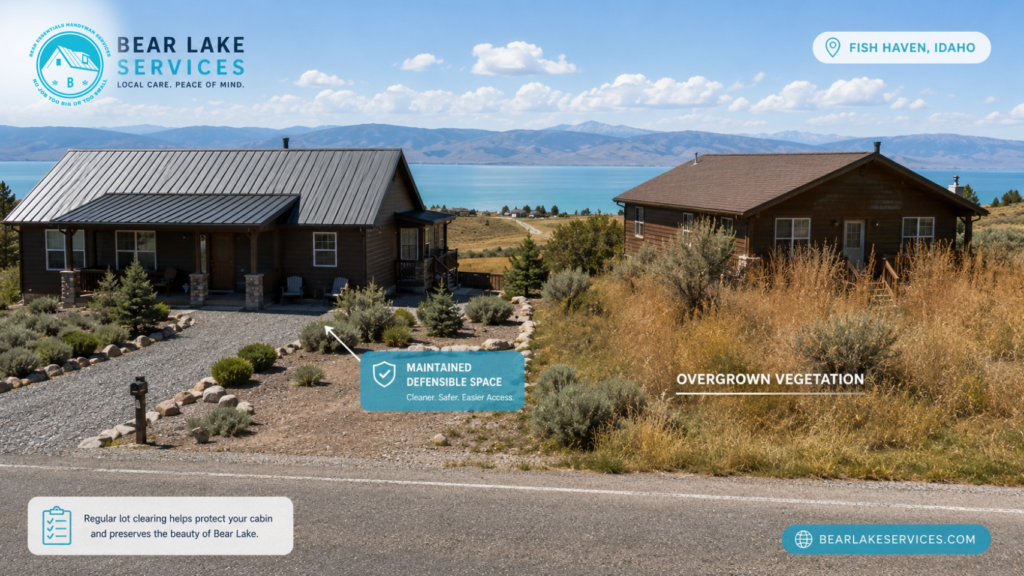
Across Idaho, wildfire agencies encourage homeowners to think about the space immediately surrounding their homes—not because every property is at immediate risk, but because vegetation management plays an important role in overall wildfire preparedness.
The National Fire Protection Association (NFPA) recommends reducing combustible vegetation close to structures and creating defensible space around homes where appropriate.
Similarly, Idaho Firewise recommends maintaining defensible space around homes, beginning with an immediate zone extending five feet from the structure where combustible materials should be minimized whenever possible.
These recommendations don’t mean every property should look identical.
A hillside cabin overlooking Bear Lake will have different needs than a smaller vacation home closer to town.
But they all share one common question:
Is vegetation growing closer to the house than it should?
That’s usually where the conversation starts.
Not with panic.
Not with fear.
Just with a practical look around the property.
How close should weeds and brush be to your cabin?
There isn’t one measurement that fits every property.
The amount of vegetation around your cabin depends on:
- the slope of your property
- surrounding vegetation
- nearby structures
- prevailing winds
- local recommendations
- how the property is used
However, wildfire organizations generally agree on one principle:
The closer combustible vegetation is to a structure, the more attention it deserves.
The immediate area surrounding the home deserves the highest level of maintenance.
That includes areas around:
- decks
- stairways
- propane tanks
- outdoor HVAC equipment
- walkways
- gravel driveways
- storage sheds
- outdoor gathering areas
This doesn’t mean stripping your property of every native plant.
Many Bear Lake cabins are intentionally designed to blend into the surrounding landscape.
The goal is thoughtful maintenance—not over-clearing.
Areas Bear Lake cabin owners often overlook
| Area | Why It Matters |
| Around decks | Weeds and brush often grow underneath and along the edges where they’re easy to miss. |
| Beside the cabin | Narrow side yards can become overgrown without owners noticing. |
| HVAC condenser units | Vegetation may restrict airflow or hide maintenance issues. |
| Gravel driveways | Weeds commonly spread along the edges over time. |
| Around propane tanks | Keeping vegetation managed helps maintain access for inspections and service. |
| Walkways and stairs | Overgrowth can reduce visibility and make access less convenient for guests. |
How do I know if my Bear Lake property needs brush clearing?
Every property grows differently.
Some cabins may only need seasonal trimming.
Others can become heavily overgrown in just a few months, especially if no one is regularly checking the property.
A good rule of thumb is this:
If the vegetation is making your property harder to inspect, maintain, or safely move around, it’s probably time to consider clearing it.
You may want to schedule brush clearing if:
- weeds are growing against the siding
- sagebrush has spread beneath the deck
- tall grasses surround your outdoor air conditioning unit
- guests have difficulty walking around the property
- vegetation blocks views of retaining walls or foundations
- overgrowth makes it difficult to inspect the exterior
- you haven’t visited the property in several months
- your cabin is primarily used as a vacation home or short-term rental
For many owners, the biggest issue isn’t that the vegetation grows quickly.
It’s that no one notices until they’re finally back at the cabin.
That’s one of the biggest differences between local homeowners and seasonal cabin owners.
If you’re only visiting a handful of weekends each year, it’s easy for small maintenance issues to become much larger projects by the time you arrive.
I only visit my cabin a few times a year. Is lot clearing still worth it?
For many Bear Lake property owners, the answer is yes—but not necessarily because the lot looks overgrown.
The bigger question is whether anyone is noticing what is happening between visits.
A cabin that sits empty for several weeks can change more than most owners expect.
Weeds grow taller.
Brush spreads around the deck.
Driveway edges become harder to access.
Tree limbs may fall after summer storms.
An outdoor air conditioning unit can become surrounded by vegetation.
These changes usually happen gradually.
That is why many out-of-area owners find themselves spending the first day of every visit catching up on maintenance instead of enjoying the property.
Bear Lake Services has seen this firsthand.
Many cabin owners call after arriving for the weekend only to discover that the property needs much more attention than expected.
Instead of scheduling emergency cleanup every time they visit, many owners choose recurring maintenance so the property is looked after throughout the season.
Can lot clearing be part of a monthly cabin maintenance program?
Absolutely.
In fact, this is the direction Stu and the Bear Lake Services team are focusing on as more owners ask for ongoing property care instead of one-time repairs.
Rather than waiting for something to become an emergency, the idea is to create a maintenance relationship with the property.
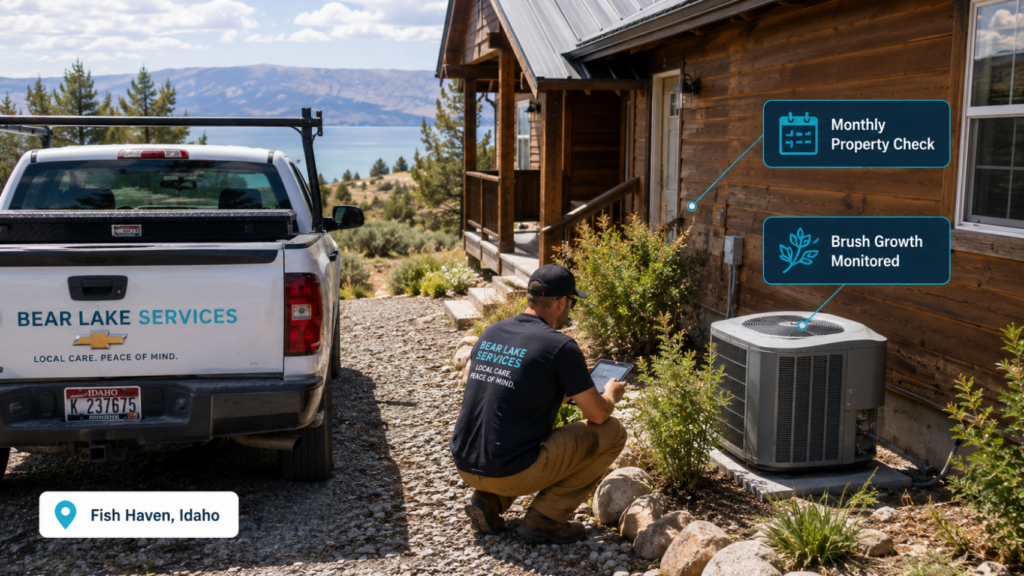
A monthly cabin check gives owners local eyes on their cabin while they are away.
During those visits, visible concerns can be identified before they become larger maintenance projects.
That may include:
- brush growing against the cabin
- weeds around outdoor equipment
- storm debris
- damaged window screens
- loose deck boards
- clogged gutters
- standing water
- exterior damage
- access concerns
- seasonal maintenance needs
One service naturally leads into another.
For example, a cabin owner may begin with monthly property checks.
During a routine visit, the team notices weeds growing around the deck and HVAC equipment.
Instead of discovering the issue months later, the owner can decide whether to schedule lot clearing while the crew is already familiar with the property.
That is much easier than trying to coordinate several contractors after arriving for a holiday weekend.
What does Stu’s Monthly Cabin Check Program include?

During a planning meeting for Bear Lake Services’ upcoming maintenance program, Stu explained that the goal is to provide peace of mind for owners who are not always nearby.
While every property is different, the recurring maintenance program is designed around ongoing property care rather than emergency-only service.
Depending on the owner’s needs, the program may include:
- recurring cabin checks
- local emergency contact support
- visual property walkthroughs
- maintenance recommendations
- coordination of needed repairs
- emergency response when required
Stu also explained several program features that can make ongoing maintenance more convenient for participating owners.
For example:
- the first hour of emergency labor is prepaid through the program if an emergency call covered by the membership occurs
- trip charges may be waived for participating members when scheduling routine maintenance work
- owners have a local contact who already knows the property
Rather than trying to find someone every time a new issue appears, the owner already has an established relationship with a local team.
As seasons change, additional services can be added naturally.
Many owners eventually combine monthly cabin checks with:
- lot clearing
- gutter cleaning
- HVAC seasonal maintenance
- screen replacement
- handyman repairs
- deck maintenance
- snow removal
- winterization
- spring opening services
Instead of hiring multiple companies throughout the year, maintenance becomes easier to coordinate because one team already understands the property.
Can weeds around my air conditioner cause problems?
This was one of Stu’s biggest recommendations during our planning discussion.
He encouraged cabin owners to take a look at their outdoor air conditioning condenser before the hottest part of summer.
One simple question he asks is:
“Is your AC unit still level?”
Outdoor equipment can shift over time because of frost movement, erosion, settling soil, or changes around the equipment pad.
The U.S. Department of Energy also recommends keeping outdoor condenser units clear of leaves, weeds, and debris so air can circulate properly around the equipment.
Source:
https://www.energy.gov/energysaver/air-conditioner-maintenance
ENERGY STAR similarly recommends routine outdoor maintenance to help systems operate efficiently.
Source:
https://www.energystar.gov/saveathome/heating-cooling/maintenance-checklist
Bear Lake Services does not replace licensed HVAC service where one is required.
However, during routine property visits, obvious concerns—such as vegetation surrounding the unit, blocked airflow, or visible maintenance needs—can be identified so owners know when additional HVAC service may be appropriate.
Should I clear everything or keep the property natural?
Many Bear Lake owners ask this question.
The answer is usually somewhere in the middle.
One of the things that makes Bear Lake beautiful is its natural landscape.
Native sagebrush, rolling hills, open space, and mountain views are part of the area’s character.
Most owners are not trying to eliminate that.
Instead, they simply want the property to remain:
- accessible
- easier to inspect
- easier to maintain
- comfortable for guests
- practical throughout the summer
Lot clearing is not about removing every native plant.
It is about deciding which vegetation supports the property—and which vegetation has become a maintenance concern.
What should I ask before hiring a lot clearing company?
Choosing a contractor isn’t just about who owns the biggest mower.
Ask questions that help you understand how they approach ongoing property care.
Some good questions include:
- What areas of the property will you clear?
- Do you work on seasonal cabins?
- Can you combine lot clearing with recurring cabin checks?
- Can you monitor the property throughout the summer?
- Will you notify me if you notice other maintenance concerns?
- Can additional handyman services be scheduled during the same visit?
- Do you provide before-and-after photos?
- Can brush clearing be combined with seasonal maintenance?
Those answers often tell you more than the quote itself.
Final Thought
Lot clearing is often viewed as a one-time cleanup project.
For many Bear Lake property owners, it becomes much more valuable when it is viewed as part of a year-round maintenance plan.
If you only visit your cabin a few weekends each year, the challenge usually is not knowing how to clear brush.
The challenge is knowing when it needs attention.
That is where recurring property care becomes valuable.
Instead of arriving to surprises every season, you have someone local who can keep an eye on the property, identify visible maintenance concerns, and help coordinate services before small problems become larger projects.
Whether your cabin needs brush clearing, weed removal, monthly cabin checks, handyman repairs, seasonal maintenance, or emergency contact support, the goal remains the same:
Keep the property ready so you can spend more time enjoying Bear Lake—and less time catching up on maintenance.
If you own a cabin, vacation rental, or second home in Fish Haven, Garden City, Bloomington, or the surrounding Bear Lake communities, contact Bear Lake Services to learn more about lot clearing, monthly cabin checks, and year-round property maintenance.
Frequently Asked Questions
Is lot clearing different from brush clearing?
The terms are often used interchangeably. Around Bear Lake, both generally refer to cutting or removing weeds, brush, tall grasses, and overgrown vegetation to improve property access and maintenance.
When is the best time to schedule lot clearing?
Late spring through mid-summer is often the best time because vegetation grows rapidly during this period. The ideal timing depends on your property’s location, weather conditions, and how quickly vegetation returns.
Do I need lot clearing every year?
Not necessarily.
Some properties only need occasional maintenance, while others require seasonal clearing because of vegetation growth, slope, or limited owner visits.
Can lot clearing help vacation rental properties?
Yes.
Keeping the property maintained can improve guest access, make exterior inspections easier, and reduce last-minute maintenance before guest arrivals.
Does Bear Lake Services remove the debris?
The scope of work varies by property. Ask what is included when requesting a quote so you understand how vegetation and debris will be handled.
Can monthly cabin checks help me know when lot clearing is needed?
Yes.
Recurring property visits allow visible vegetation growth and maintenance concerns to be identified before they become larger cleanup projects.
Is lot clearing the same as wildfire mitigation?
No.
Lot clearing is one maintenance practice that may support broader wildfire preparedness, but it does not guarantee wildfire protection. Property owners should also review recommendations from Idaho Firewise, FEMA, NFPA, and any local requirements that apply to their property.
Sources
- Utah Public Radio – Bear Lake housing and seasonal home study
- Idaho Firewise – Firewise Landscaping & Defensible Space
- National Fire Protection Association – Preparing Homes for Wildfire
- Ready.gov – Wildfires
- U.S. Department of Energy – Air Conditioner Maintenance
- ENERGY STAR – HVAC Maintenance Checklist