


26 Oct Deck Snow Removal Bear Lake: What Cabin Owners Should Know
Snow on a cabin deck can be easy to overlook. The driveway gets attention because you need it to reach the property, while a back deck may sit untouched between winter visits.
For Bear Lake cabin owners, however, deciding whether a deck needs snow removal involves more than looking at how many inches have accumulated. The deck’s construction and condition matter, snow can vary considerably in weight, drifting can create uneven accumulation, and the way snow is removed matters too.
That is especially relevant for seasonal properties. If you’re away for several weeks, you may not know whether the deck has a light layer of relatively dry snow, repeated accumulation from several storms, drifting in one area, or snow that has gone through cycles of melting and refreezing.
This guide explains what property owners should consider when planning deck snow removal in Bear Lake, without relying on universal snow-depth rules that may not apply to an individual structure.
Does Snow Need to Be Removed From Every Cabin Deck?
Not necessarily after every snowfall.
A light covering of snow on a sound deck is not automatically evidence of a structural problem. Residential decks are designed to carry loads, and modern building codes include structural loading requirements for exterior decks. The 2021 International Residential Code, for example, lists a minimum uniformly distributed live load of 40 pounds per square foot for exterior balconies and decks.
Snow loading is more complicated than simply measuring depth, however. The American Wood Council notes that its prescriptive residential wood deck guidance can be conservatively applied under specified conditions to a deck with a uniformly distributed snow load of 40 psf and a 10 psf dead load when the deck is not prone to sliding or drifting snow. That is a design reference, not a universal instruction to wait until every deck reaches 40 psf before taking action.
An existing Bear Lake cabin deck may have been built under a different code, altered since construction, weathered over time, or have structural conditions that cannot be determined from its appearance alone. A generic internet number therefore cannot establish the safe snow capacity of an individual deck.
Why Isn’t Snow Depth Enough to Tell You What’s on the Deck?
Ten inches of snow doesn’t always represent the same load.
Snow density and water content can vary, and conditions can change as snow settles, melts, absorbs additional moisture or refreezes. This is why structural snow guidance deals with load, not simply the visible depth of snow.
FEMA’s Snow Load Safety Guide emphasizes the importance of understanding a building’s design conditions when evaluating snow accumulation. The guide also explains that snow-related structural risk depends on more than one variable and that preventative planning should happen before significant snow events.
That same caution is useful when thinking about a cabin deck. A photograph showing “12 inches of snow” isn’t enough to calculate what an unfamiliar deck can safely support.
For property owners, the useful takeaway is simple: don’t use a universal inches-of-snow rule as a substitute for information about the actual structure.
Why Does Drifting Matter on a Cabin Deck?
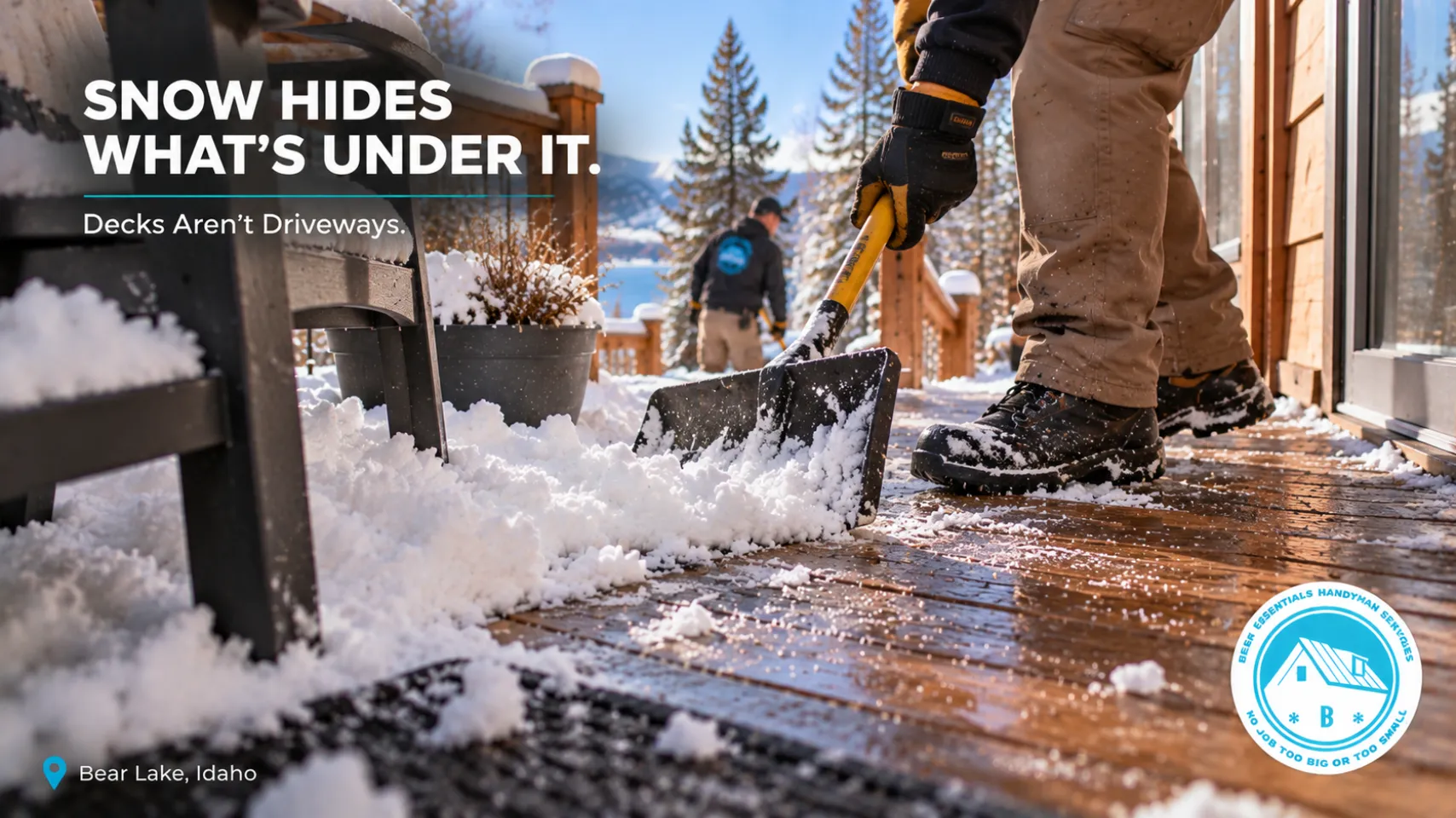
Snow doesn’t always accumulate evenly.
Wind and the surrounding building geometry can cause snow to collect more heavily in certain locations. A deck beside the cabin may experience different accumulation near walls, railings, corners or other areas where wind patterns allow snow to collect.
The American Wood Council specifically distinguishes decks that are not prone to sliding or drifting snow when discussing application of its prescriptive deck guidance to snow loads.
For a cabin owner, that means the overall appearance of the deck may not tell the whole story. One section may remain relatively exposed while another develops a deeper accumulation.
If you aren’t at the property, this is also one reason a current look at the deck can be more useful than relying solely on a weather report for the surrounding area.
What Should You Look at Before Removing Snow From a Deck?
Start with the deck itself.
If a railing already moves, boards feel unusually soft, connections appear questionable, supports show visible deterioration, or the deck has other known structural concerns, adding people and snow-removal activity deserves additional caution.
This connects directly with something we covered in our earlier Bear Lake deck guide: surface appearance alone doesn’t establish structural condition. Weathered boards, structural framing, connections, railings and supports are different parts of the deck system and should not be treated as interchangeable.
The International Residential Code contains specific structural provisions for deck posts, beams, joists, connections and loading. Current code tables also account for snow-load conditions when sizing certain deck components.
For an older or unfamiliar cabin deck, its actual capacity should not be guessed from a photograph or from the apparent depth of the snow.
This isn’t a diagnostic checklist. It is a way to identify when snow removal on a deck may require more thought than simply grabbing a shovel.
Should You Clear the Entire Deck or Just the Area You Need?
This depends partly on why the deck is being used.
For some Bear Lake cabins, the deck is an important winter entrance. In that case, the immediate goal may be maintaining practical access between the door, deck and stairs.
Another deck may be unused throughout winter. A large wraparound deck, elevated deck or deck with significant accumulation presents a different scope from clearing a modest walking route.
There is no reason to assume every square foot of every deck must remain bare throughout winter.
Instead, the service scope should reflect the property, how the deck is used, existing accumulation and any structural concerns. That also helps avoid treating cabin deck snow removal as if it were identical to clearing a flat driveway with snow-removal equipment.
Why Is Deck Snow Removal Different From Driveway Snow Removal?
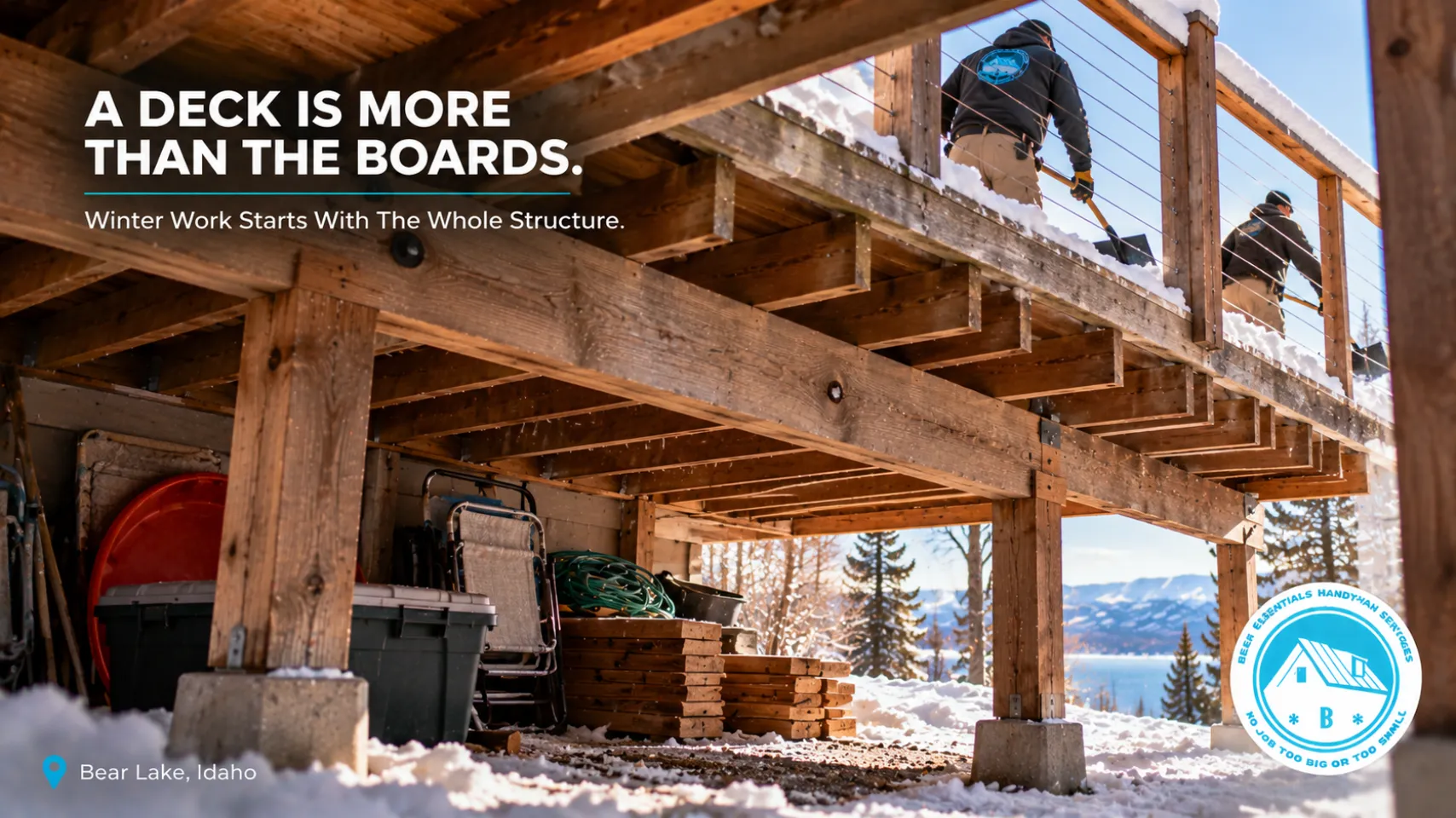
A driveway is a ground-level surface designed primarily for vehicle and pedestrian access. An elevated deck is a structural system.
Underneath the decking are joists, beams, posts, footings and connections transferring loads through the structure. The American Wood Council’s residential deck construction guidance addresses these components individually because their sizes, spans, connections and tributary loads affect how the system performs.
The surface itself is different as well. Deck boards may be wood or another decking material, and railings, stairs, furniture, planters and other objects can make mechanical snow removal impractical or inappropriate.
This is why a winter property plan should identify driveway snow removal and deck snow removal as separate areas of work, even when the same property needs both.
Can Snow Removal Damage a Wood Deck?
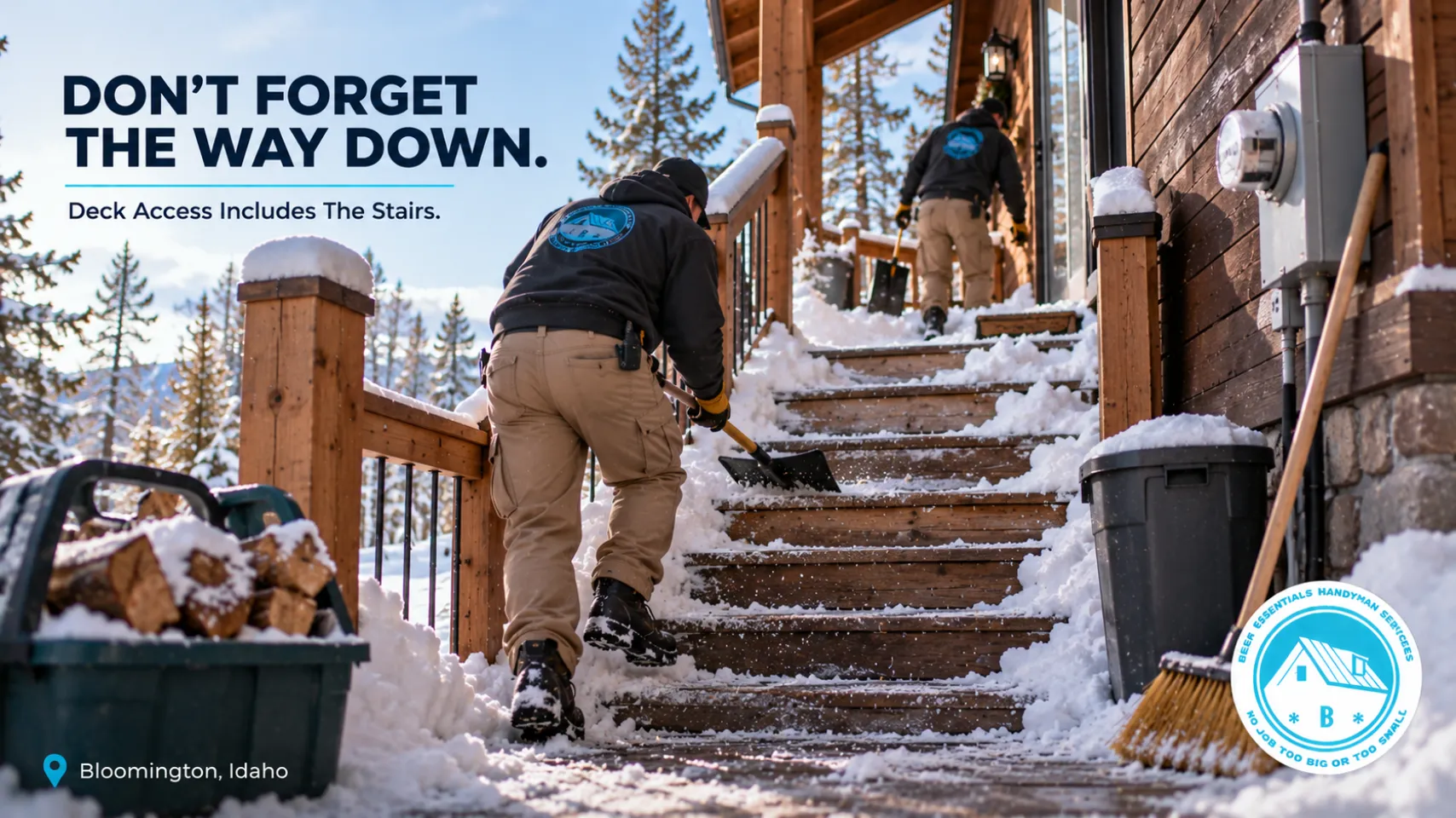
Poor technique can damage deck surfaces or components.
Aggressive contact with decking, railings or stairs can create physical damage, particularly when the operator cannot clearly see what is underneath accumulated snow. Decks can also contain fasteners, changes in elevation and other features that may be obscured.
Wood itself is an exterior material exposed to repeated environmental conditions. USDA Forest Service research on wood decks documents the importance of weathering, moisture exposure and protective finishes in long-term deck performance. The Forest Products Laboratory has studied exterior deck finishes specifically for water repellency, mildew resistance and weathering performance.
Snow removal does not replace normal deck maintenance. Once winter ends, boards, finishes, railings and structural components may still need evaluation based on their actual condition.
That distinction is important for Bear Lake Services because deck repair, deck staining and snow removal solve different property problems, even though all three can involve the same deck at different points in the year.
What About Ice on the Deck?
Ice changes both the surface condition and the way the area can be approached.
Trying to force ice away mechanically can create a different risk of damaging the decking, stairs or adjacent components. Chemical deicers also shouldn’t automatically be assumed appropriate for every decking material or surrounding environment.
Product compatibility depends on the deck material and the product being considered. Owners should follow the decking manufacturer’s maintenance guidance and the deicer manufacturer’s instructions rather than relying on a universal “use this on every deck” recommendation.
If ice is repeatedly developing in the same area, it can also be useful to understand where the water is coming from. Snowmelt from another surface, drainage patterns, roof runoff or repeated freeze-thaw conditions may all warrant separate investigation depending on the property.
What If Snow From the Roof Falls Onto the Deck?
This deserves particular attention because roof and deck accumulation are not always independent.
A deck located below a roof edge may receive snow that slides or falls from above. Depending on the building geometry and conditions, that can create localized accumulation rather than the relatively uniform snow layer someone might expect from snowfall alone.
It also creates an important work-area consideration: anyone clearing the deck needs to be aware of conditions overhead.
OSHA’s snow-removal guidance identifies falling snow and ice, falls, cold exposure, overexertion and structural hazards among the risks associated with removing snow from roofs and elevated surfaces. While OSHA’s guidance is written for worker safety, it illustrates why snow removal around elevated building surfaces should be planned rather than approached casually.
If roof accumulation itself is the concern, that becomes a separate evaluation from clearing the deck below.
Should You Shovel a Snow-Covered Deck Yourself?
A small, structurally sound, readily accessible deck with manageable snow conditions is very different from a high deck with questionable framing, heavy accumulation, significant ice or difficult access.
Homeowners should consider their own physical ability, footing, weather conditions, the deck’s condition and whether the work can be performed without creating another hazard.
Snow removal is physically demanding. OSHA identifies overexertion and musculoskeletal injuries among snow-removal hazards, along with cold-related risks such as frostbite and hypothermia.
There is also a practical issue that is easy to underestimate: once the deck starts being cleared, the snow needs somewhere appropriate to go.
Moving it from the center of the deck to a stairway, doorway, service area or another place that still needs access doesn’t necessarily solve the property problem.
Where Should Removed Deck Snow Go?
This should be considered before work begins.
A deck may sit above landscaping, a lower walkway, another entrance or equipment that should not simply receive everything removed from above. Snow placement can also affect the next part of the job if it blocks the stairs or creates another pile that must then be moved again.
That is one reason our broader snow removal in Bear Lake strategy starts with the layout of the property. Driveways need space for removed snow, and decks do too.
For seasonal cabin owners, a useful snow-removal scope can identify:
which portion of the deck needs to remain accessible;
which stairs or doors are part of that route;
where snow can reasonably be moved; and
whether roof conditions above the work area need separate attention.
Those are property-specific decisions. They cannot be answered by a generic snow-removal package.
What If Nobody Is at the Cabin After It Snows?
This is where Bear Lake cabin maintenance and snow removal start to overlap.
A cabin owner living elsewhere may know that Bear Lake received snow without knowing exactly what happened at the property. The driveway, deck and roof can each accumulate differently, and wind can redistribute snow around the building.
Bear Essentials Handyman Services is based in Fish Haven and provides year-round property care for local and out-of-town owners. Its current services include seasonal care such as snow removal and ice-dam removal, along with decks, exterior repairs and property maintenance.
For owners who need ongoing local oversight rather than only a snow-removal visit, the company’s Monthly Emergency Contact & Property Check Program is a separate service built around scheduled property visits, interior and exterior walkarounds, and written photo reports.
Keeping those services distinct matters. Snow removal handles a defined winter job. A property check gives an owner current information about a property they cannot physically see themselves.
How Should You Plan Deck Snow Removal Before Winter?
Before regular winter weather arrives, take a few minutes to look at the deck while you can still see all of it.
Check how the deck connects to the cabin. Look at the stairs and railings. Note where furniture, grills and planters will remain. Decide whether the deck will be used as an entrance or whether it can remain largely unused through winter.
If the deck has known deterioration or questionable structural conditions, address those concerns rather than assuming snow removal solves them. Bear Lake Services’ existing deck-maintenance work covers repair, installation and staining in addition to seasonal property care.
For cabins that will be occupied during winter, establish the access route from the driveway all the way to the door. That may involve more than one surface:
Planning these areas together makes the service more useful without pretending they are all the same type of work.
When Should a Deck Be Evaluated Instead of Simply Cleared?
If you have reason to question the deck’s structural condition, snow removal shouldn’t be used as a substitute for evaluation.
Visible deterioration, movement, damaged structural components or an unknown deck history may justify a closer look. Likewise, unusually concentrated accumulation or concern about the deck’s capacity cannot be resolved by applying a generic online snow-depth threshold.
Modern residential deck provisions demonstrate why. Deck capacity depends on a system of components—including decking, joists, beams, posts, footings and connections—and current prescriptive guidance changes component requirements as loads and dimensions change.
If structural capacity is genuinely in question, an appropriately qualified professional should evaluate the structure.
Deck Snow Removal for Bear Lake Cabins
For many seasonal properties, the deck is the space between “the driveway is clear” and “I can actually use the cabin.”
It may contain the entrance you use, stairs that connect different areas of the property, or an outdoor space that needs occasional winter access. Other decks may remain unused for months and require a completely different approach.
Bear Essentials Handyman Services provides snow removal and year-round property maintenance around Bear Lake, alongside deck repair and other seasonal services. The company is based in Fish Haven and works with both local and out-of-town property owners.
If you’re planning winter service, define the deck separately from the driveway. Explain how the property is used, which access areas matter and whether there are existing concerns about the deck itself.
That gives the crew something much more useful than a request to simply “remove the snow.”
Frequently Asked Questions
How much snow can a cabin deck hold?
There is no universal snow-depth answer for every deck. Capacity depends on the structure’s design, dimensions, materials, condition and loading. Snow weight also cannot be determined reliably from depth alone. Current building guidance accounts for structural loads rather than using one universal depth threshold.
Do I need to remove snow from my deck after every storm?
Not necessarily. Whether removal is appropriate depends on accumulation, drifting, how the deck is used, the structure’s condition and other property-specific factors. A light covering of snow does not automatically indicate a structural problem.
Is deck snow removal the same as driveway snow removal?
No. A deck is an elevated structural system containing joists, beams, posts, footings and connections. It can also include railings, stairs and surface materials that require a different approach from ground-level driveway clearing.
Can I use a snow blower on my deck?
Do not assume that a particular machine is suitable for every deck. The appropriate method depends on the equipment, deck surface, layout, snow conditions and manufacturer’s instructions. If there is a risk of damaging the deck or operating the equipment unsafely, use another appropriate method or professional service.
What should I do if my deck already feels unstable?
If the deck has movement, damaged components or other signs that raise structural concerns, have the condition appropriately evaluated. Removing snow does not correct an underlying structural problem.
Can Bear Lake Services check my cabin when I’m away?
Bear Essentials Handyman Services currently offers a Monthly Emergency Contact & Property Check Program for cabin and vacation-home owners. The program includes scheduled visits, interior and exterior walkarounds and written photo reports.
References
These are the sources used for the factual and structural guidance in this article:
International Code Council — 2021 International Residential Code, Chapter 3: Building Planning Includes residential loading provisions and the minimum uniformly distributed live load for exterior decks.
International Code Council — 2021 IRC, Section R507.4: Deck PostsShows how prescriptive deck component requirements account for different load conditions, including ground snow loads.
American Wood Council — DCA 6 Prescriptive Residential Wood Deck Construction GuideTechnical guidance covering residential wood deck joists, beams, posts, footings, connections and design assumptions.
American Wood Council — Deck Live Load / Snow Load FAQExplains DCA 6’s 40 psf live-load basis and its limited application to uniformly distributed snow loads when decks are not prone to sliding or drifting snow.
FEMA — Snow Load Safety Guide (FEMA P-957)Federal guidance on preparing for, evaluating and responding to snow-load conditions.
OSHA — Falls and Other Hazards to Workers Removing Snow from Rooftops and Other Elevated Surfaces Covers fall hazards, structural considerations, overexertion, cold exposure and other risks associated with elevated snow removal.
USDA Forest Service, Forest Products Laboratory — Protecting Wood Decks from Biodegradation and WeatheringResearch on weather exposure and protective finish performance for exterior wood decks.
Bear Lake Handyman Services — Property MaintenanceCurrent first-party information about Bear Lake property maintenance and cabin care.
Bear Lake Handyman Services — Main WebsiteCurrent service and location information, including year-round property care for local and out-of-town owners.