

30 Sep What Can You Do About an Overgrown Bear Lake Property Before Fall?
Written by Stu, Lead Technician at Bear Lake Services, serving Bear Lake, Fish Haven, Bloomington, Garden City, and surrounding communities with handyman services, property maintenance, seasonal care, repairs, and property improvements.
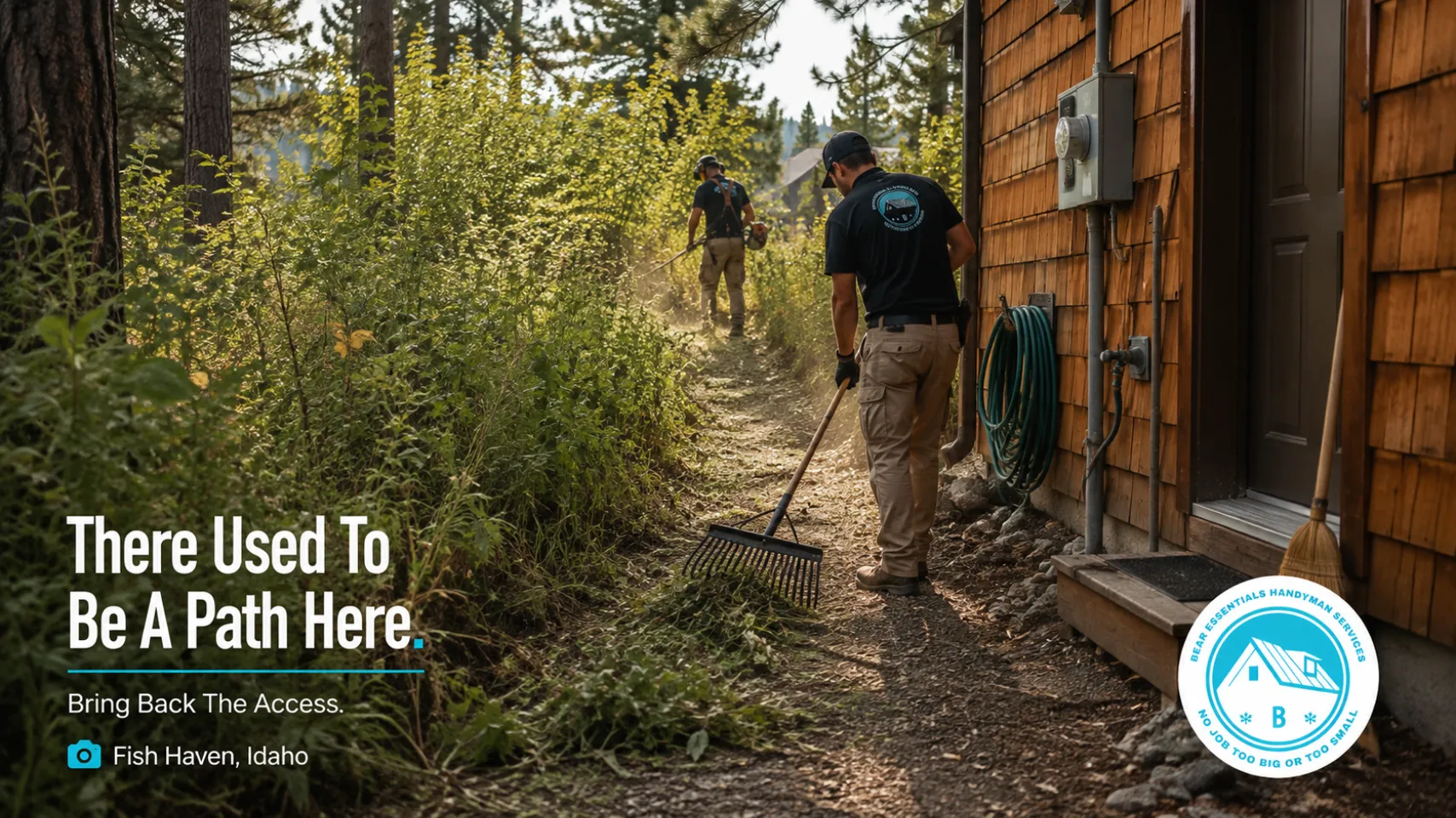
You arrive at your Bear Lake cabin in September and realize the property looks very different from the one you opened earlier in the summer. Weeds have filled areas you barely noticed in June, brush is pushing toward a walkway, branches are hanging lower around an access area, and vegetation has grown into places you normally need to reach around the cabin.
That doesn’t necessarily mean the entire property needs to be cleared. September is a useful time to look at what summer growth changed around the property and decide which areas are simply untidy, which are interfering with access or maintenance, and which may deserve professional clearing before the season changes.
For a seasonal cabin owner, the better question isn’t, “How do I clear everything?”
It’s: “What growth is actually creating a problem?”
Has Summer Growth Actually Created a Problem Around the Cabin?
An overgrown property can mean many different things. One cabin may have tall weeds around a utility area. Another may have brush narrowing a path to the side of the house. Somewhere else, vegetation may have grown around a drainage route, against a structure, or into an area that needs to remain accessible for maintenance.
That distinction matters because vegetation is part of the property. The goal shouldn’t automatically be to strip a cabin lot bare. Instead, walk the site and identify where unwanted growth is interfering with how the property functions.
A practical September assessment can begin with the cabin itself and move outward toward walkways, driveways, utility areas, drainage paths and the rest of the lot.
The useful decision isn’t clear versus don’t clear. It’s deciding how much intervention the condition actually requires.
What Should You Deal With Closest to the Cabin First?
Start where vegetation interacts with something you need to use, inspect or maintain.
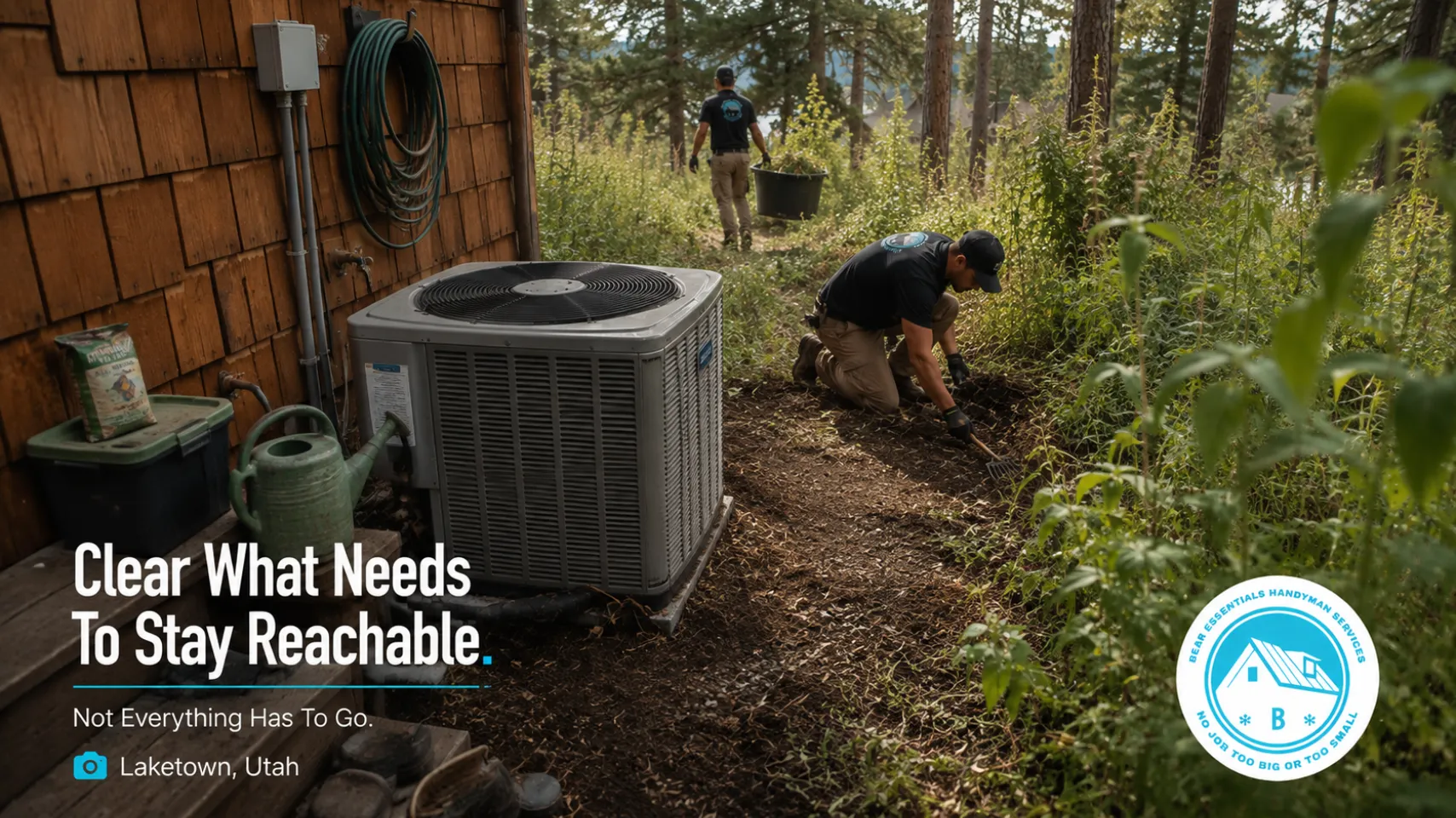
Look around exterior doors, steps, decks, HVAC equipment, hose connections, utility areas, windows, walkways and other service points. Vegetation that has grown into these spaces may make routine access more difficult and can conceal the area you’re trying to inspect.
Dead vegetation also deserves attention around structures. USDA Forest Service wildfire guidance recommends reducing accumulations of flammable vegetation around homes as part of defensible-space maintenance, including removing dead plant material and reducing vegetation near structures.
This article isn’t another summer fire-preparation guide, however. In September, the broader property-maintenance reason is equally practical: you want to be able to see and reach the parts of the cabin that may need attention before colder weather arrives.
Should I Cut Down Every Weed Before Fall?
No. “Weed” isn’t one maintenance category, and timing matters.
Utah State University Extension notes that annual and perennial weeds behave differently. Some annual weeds die around the first hard frost, while perennial weeds can survive from established roots. USU also identifies early fall as an effective period for controlling several perennial broadleaf weeds because systemic herbicides applied to actively growing plants can move into the roots.
That doesn’t mean every overgrown Bear Lake lot should receive herbicide treatment. Correct plant identification matters, products must be appropriate for the site and applied according to their labels, and vegetation near desirable plants requires particular care. USU specifically cautions that herbicide effectiveness and the potential for injury to desirable vegetation depend on factors including product, temperature, wind and application location.
For ordinary property cleanup, mowing, cutting, hand removal or selective clearing may be enough. The important thing is not to assume every patch of unwanted growth requires the same treatment.
What About Brush Growing Along the Cabin, Deck, or Fence?
This is where selective clearing often makes more sense than indiscriminate lot clearing.
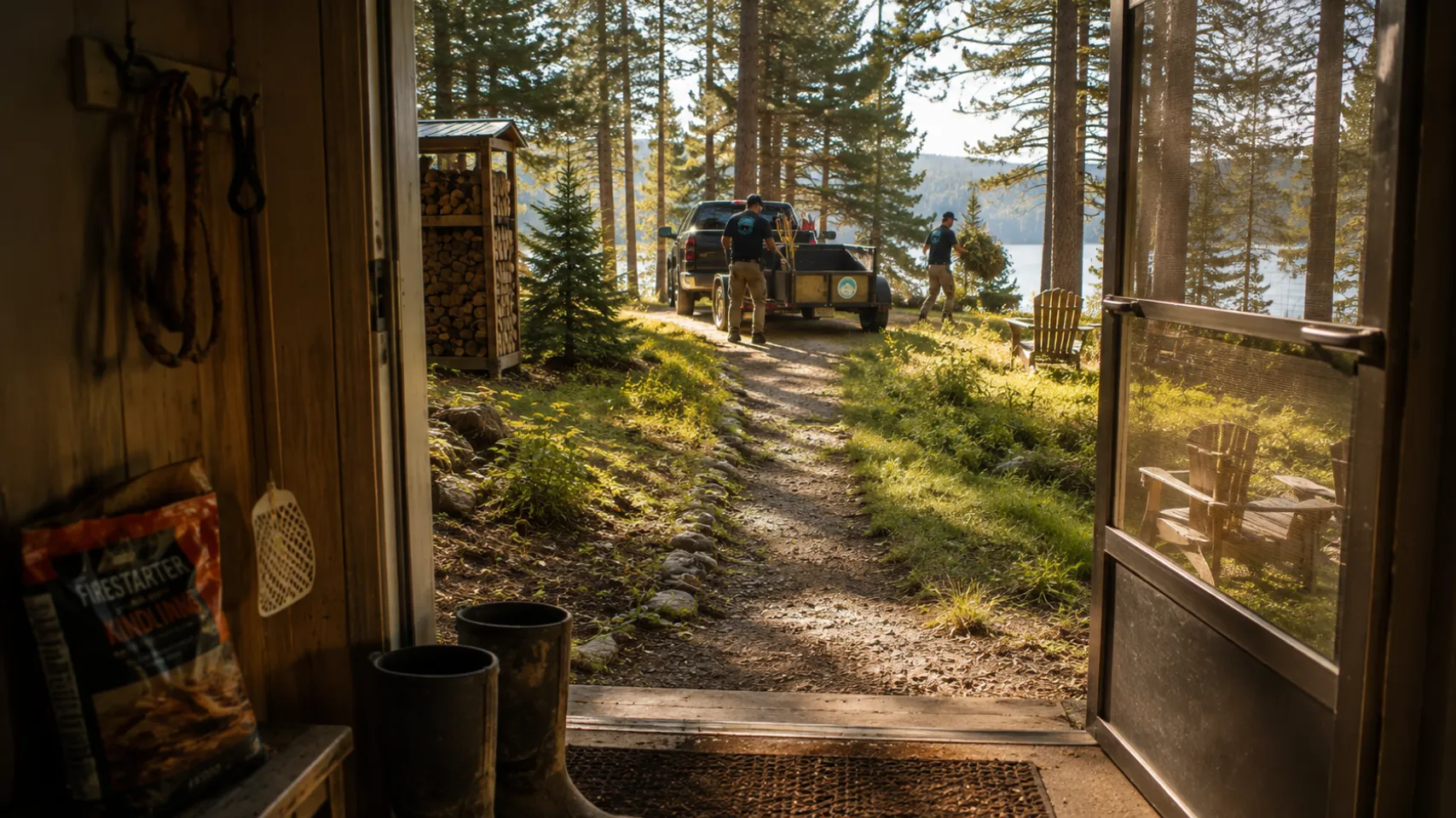
Brush that has expanded into a walkway, around deck access, alongside a fence or into an area needed for exterior maintenance can be cut back enough to restore usable space. The objective is to solve the functional problem while avoiding unnecessary removal of desirable vegetation elsewhere on the property.
The same logic applies to dead branches and accumulated dead plant material. Forest Service guidance distinguishes among removal, such as removing an entire dead plant; reduction, such as pruning branches or mowing dried grass; and replacement, where vegetation is intentionally changed.
That’s a useful framework beyond wildfire preparation because it prevents “property clearing” from automatically becoming “remove everything.”
When Does Overgrowth Become an Access Problem?
Imagine needing someone to reach your HVAC unit, inspect a gutter downspout, repair siding or get equipment around the side of the cabin. If the route that was clear in May has become difficult to use by September, vegetation has moved beyond being purely cosmetic.
The same applies to driveways and paths. Branches or brush encroaching into an access route may interfere with people, vehicles or equipment. For a seasonal property, keeping ordinary service areas accessible can become particularly important when you’re relying on someone local to maintain the property while you’re away.
A useful test is simple: Could someone unfamiliar with the property clearly identify and safely reach the areas they may need to service?
If not, selective clearing may provide more value than trying to make the entire lot look manicured.
Can Overgrown Vegetation Affect Drainage?
Vegetation and drainage should be evaluated together rather than assuming plants are either always helpful or always harmful.
Plants can slow runoff and help stabilize soil, which is one reason vegetation is used in stormwater-management practices. At the same time, an existing drainage route still needs to function as intended. If accumulated plant material, debris or changes to the surrounding ground appear to be affecting a swale, downspout outlet or another established drainage path, the condition should be evaluated before simply cutting everything away.
This connects directly to another question Bear Lake cabin owners may notice after storms: Why is water suddenly pooling somewhere it didn’t before?
That’s why our September drainage article and this lot-clearing article belong in the same maintenance cluster. One begins with the water. This one begins with the vegetation. Both eventually ask whether something around the property has changed enough to affect how the site functions.
Should Dead Grass and Vegetation Be Removed Before Fall?
Dead vegetation close to structures is worth evaluating rather than simply leaving it because summer is ending.
Forest Service defensible-space guidance emphasizes removing or reducing dead and flammable vegetation around homes. That remains relevant after peak summer because vegetation management is an ongoing property-maintenance practice rather than something that becomes irrelevant when the calendar reaches September.
There is an important distinction, though. A natural cabin property doesn’t need to look like a suburban lawn. Pine needles, native vegetation and natural ground cover are normal components of many mountain properties. The decision should focus on location, accumulation, condition and function, rather than assuming every natural material needs to disappear.
What About Small Trees and Overhanging Branches?
First determine the scope.
Small woody growth that can be safely handled from ground level may fall within routine property clearing or landscaping. Larger trees, heavy limbs, trees near structures or utilities, and work requiring climbing or specialized equipment can introduce hazards that make professional tree work more appropriate.
The key is not to turn a cleanup project into a risky DIY tree-removal project because you already have a chainsaw at the cabin.
For Bear Lake Services, this distinction is useful because the company offers both lot/property clearing and tree removal. The appropriate service depends on what is actually growing on the site and the scale of the work.
When Is Hand Clearing Enough, and When Might Equipment Make More Sense?
This is often the real decision on an overgrown cabin property.
A handful of weeds beside the deck doesn’t require the same approach as dense vegetation across a large neglected portion of the lot. Conversely, bringing machinery into an area that can easily be handled by hand can create unnecessary disturbance.
Equipment selection depends on terrain, vegetation, access, nearby structures and the desired result. There isn’t a universal acreage or vegetation height at which a property suddenly “needs” machinery.
Do I Need to Clear the Entire Lot?
Usually, that’s the wrong question to begin with.
Think about the property in zones of use. The cabin perimeter serves one purpose. Driveway and service access serve another. Outdoor living areas, drainage routes and natural portions of the lot have different functions.
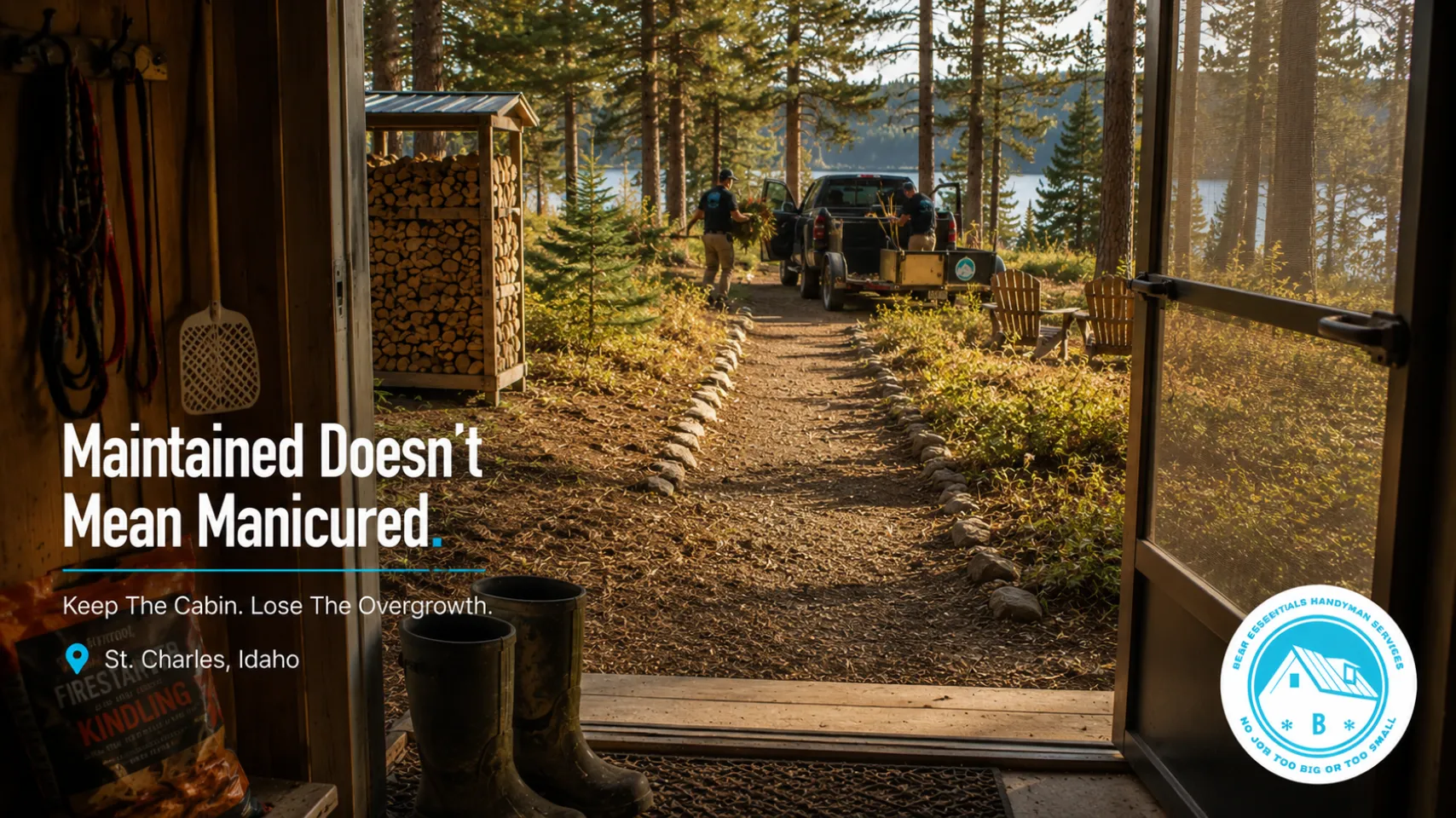
An area that doesn’t interfere with the cabin, access, drainage or another maintenance objective may not need the same level of clearing as vegetation directly beside a structure. This is especially important around Bear Lake, where many owners want a mountain-cabin property to continue looking like a mountain-cabin property.
The goal can be maintained without being over-manicured.
Is September Actually a Useful Time to Deal With an Overgrown Property?
For several maintenance tasks, yes, although the appropriate timing depends on what you’re doing.
USU’s Northern Utah turfgrass management calendar—which specifically includes Rich County—lists September for several lawn-management activities, including cool-season grass seeding, overseeding, aeration and broadleaf weed control. USU notes that these are general guidelines and should be adjusted for actual weather conditions.
USU also identifies early fall as an important period for controlling difficult perennial weeds.
For Bear Lake cabin owners, September has another practical advantage that doesn’t require a scientific claim: you’ve just seen what the property did during an entire growing season. That makes it easier to identify which areas actually got away from you.
What Should You Leave Alone?
Not everything growing on the property is a maintenance problem.
Healthy vegetation that isn’t interfering with access, structures, drainage or another property objective may simply be part of the landscape. Likewise, major pruning or tree work shouldn’t be performed merely because fall is approaching; plant species, condition and pruning objectives matter.
This is where a maintenance-first approach differs from a generic “fall cleanup.”
We’re not trying to make every Bear Lake cabin lot look identical. We’re trying to make the property usable, accessible and manageable.
What If My Bear Lake Property Got Away From Me This Summer?
That happens easily with seasonal properties because you aren’t necessarily there every week to see incremental growth.
Instead of arriving in September and treating the entire lot as one enormous cleanup project, start with the areas that affect the cabin most: access routes, the structure perimeter, service areas, drainage routes and obviously dead or unwanted vegetation. Then decide what actually needs mowing, trimming, clearing, hauling, tree work or equipment.
Bear Lake Services provides lot clearing, irrigation and landscaping, tree removal, junk removal, excavation and general property maintenance around Bear Lake. Because those services overlap, a property doesn’t have to be forced into one predetermined solution before someone has seen the condition.
For owners who aren’t at the cabin regularly, the Monthly Emergency Contact & Property Check Program can also provide scheduled property checks and written photo reports, giving owners a way to see changes around the property between visits.
Sometimes the most useful September cleanup begins with someone local showing you what summer left behind.
Frequently Asked Questions
Should I clear weeds around my Bear Lake cabin before fall?
It depends on the vegetation and where it’s growing. Weeds interfering with structures, walkways, service access or another maintenance objective may deserve attention, while different weed species require different management. USU notes that early fall can be an effective control period for several perennial weeds.
Is fall a good time for weed control in northern Utah?
It can be for certain weeds. USU’s Northern Utah calendar includes broadleaf weed control in September and October, while its weed-management guidance identifies early fall as useful for several perennial weeds. Treatment should always depend on the plant and product label.
Do I need to remove all vegetation near my cabin?
No. The objective should be appropriate vegetation management, not automatically removing every plant. Evaluate dead vegetation, unwanted growth, access, drainage and vegetation close to structures individually.
Can Bear Lake Services clear an overgrown property?
Bear Lake Services lists irrigation/landscaping, tree removal, excavation and related property-maintenance services among its service offerings. The appropriate approach depends on the property’s vegetation, terrain, access and scope.
When does lot clearing require equipment?
There is no universal threshold. Dense vegetation, large areas, woody growth, terrain and access can make mechanized work more practical, while smaller areas may be better suited to hand or powered-tool clearing.
Sources
USU Extension — Weed Control Options for Residential Lawns in Utah
USU Extension — Fall Yard and Garden Tips
USDA Forest Service — Living With Fire guidance