

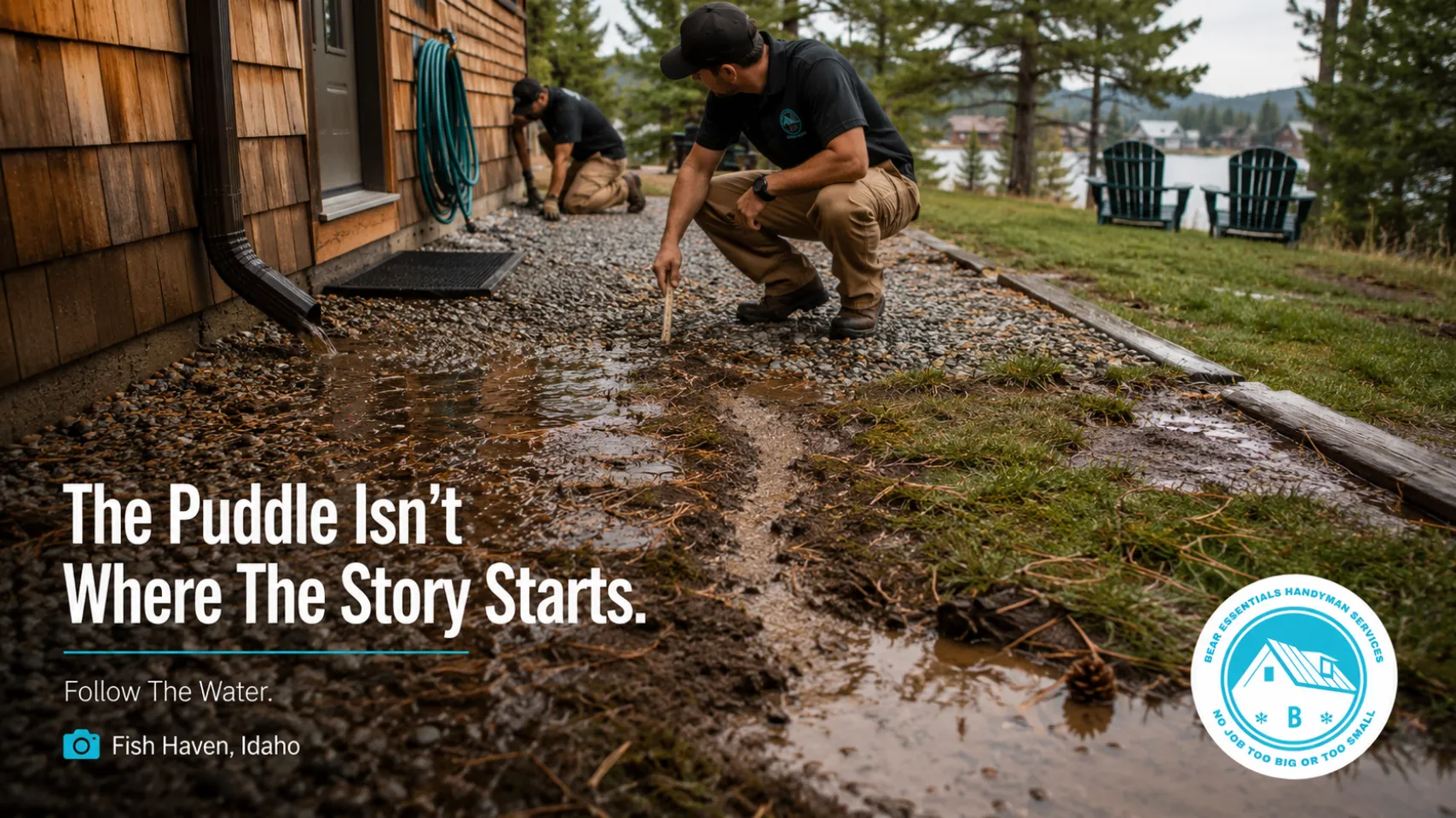
23 Sep Why Is Water Pooling Around My Cabin? What to Check Before the Next Storm
Written by Stu, Lead Technician at Bear Lake Services, serving Bear Lake, Fish Haven, Bloomington, Garden City, and surrounding communities with handyman services, property maintenance, seasonal care, repairs, and property improvements.
You walk around your Bear Lake cabin after a storm and notice something that wasn’t there before. Water is sitting beside the foundation. Gravel has washed across part of the driveway. There’s a wet area below a downspout, or a low spot near the deck is holding water longer than the surrounding ground.
The first instinct may be to blame the gutters, but water around a property rarely makes sense when you look at only one component. Rain falls on the roof, travels through gutters and downspouts, reaches the ground, and then follows the grade and drainage paths around the property. Driveways, compacted soil, landscaping and low areas can influence where surface water travels as well. The U.S. Department of Energy’s Building Science Education program emphasizes this same whole-property approach: roof runoff should be collected and directed away from the building, while the surrounding grade should also carry water away from the foundation.
So if you’re seeing water somewhere you don’t expect it around a Bear Lake cabin, don’t start by assuming you already know the repair. Start with a simpler question: Where did the water come from, and where was it trying to go?
Why Is Water Suddenly Pooling Around My Cabin?
Standing water can have several potential contributors, and seeing the water alone isn’t enough to determine which one applies to your property. A gutter may be overflowing, a downspout may discharge too close to the building, the surrounding grade may direct runoff toward a low point, or water may simply be following a drainage route that has changed as soil, gravel or landscaping has shifted.
Hard surfaces matter, too. The EPA explains that rooftops, driveways, roads and compacted soils reduce infiltration and increase surface runoff compared with surfaces where precipitation can more readily soak into the ground. For a cabin property, that means the roof and driveway aren’t separate from the drainage question. They’re part of the route water takes across the site.
Before changing anything, look at the entire route rather than only the puddle.
Start With the Water, Then Work Backward
This isn’t a diagnosis table. It’s a way to determine what deserves a closer look.
Could the Water Be Coming From the Roof?
A roof can collect a surprisingly large amount of water during rainfall, which is why roof drainage matters.
DOE’s Building Science Education guidance notes that even a few inches of rain on a house roof can generate thousands of gallons of runoff, depending on roof area and rainfall. That water needs an intentional path away from the building. Gutters collect runoff along the roof edge, downspouts carry it toward ground level, and the drainage system then needs somewhere appropriate to send it.
Instead of asking only whether your gutters contain leaves, watch what happens during or shortly after rainfall when it is safe to do so. Look from the ground for water spilling over a gutter edge, leaking at a connection, missing the gutter entirely, or reaching a downspout and then being discharged into an area where it collects.
The gutter itself may be working perfectly while the discharge location creates the problem farther downstream.
Where Does the Water Go After It Leaves the Downspout?
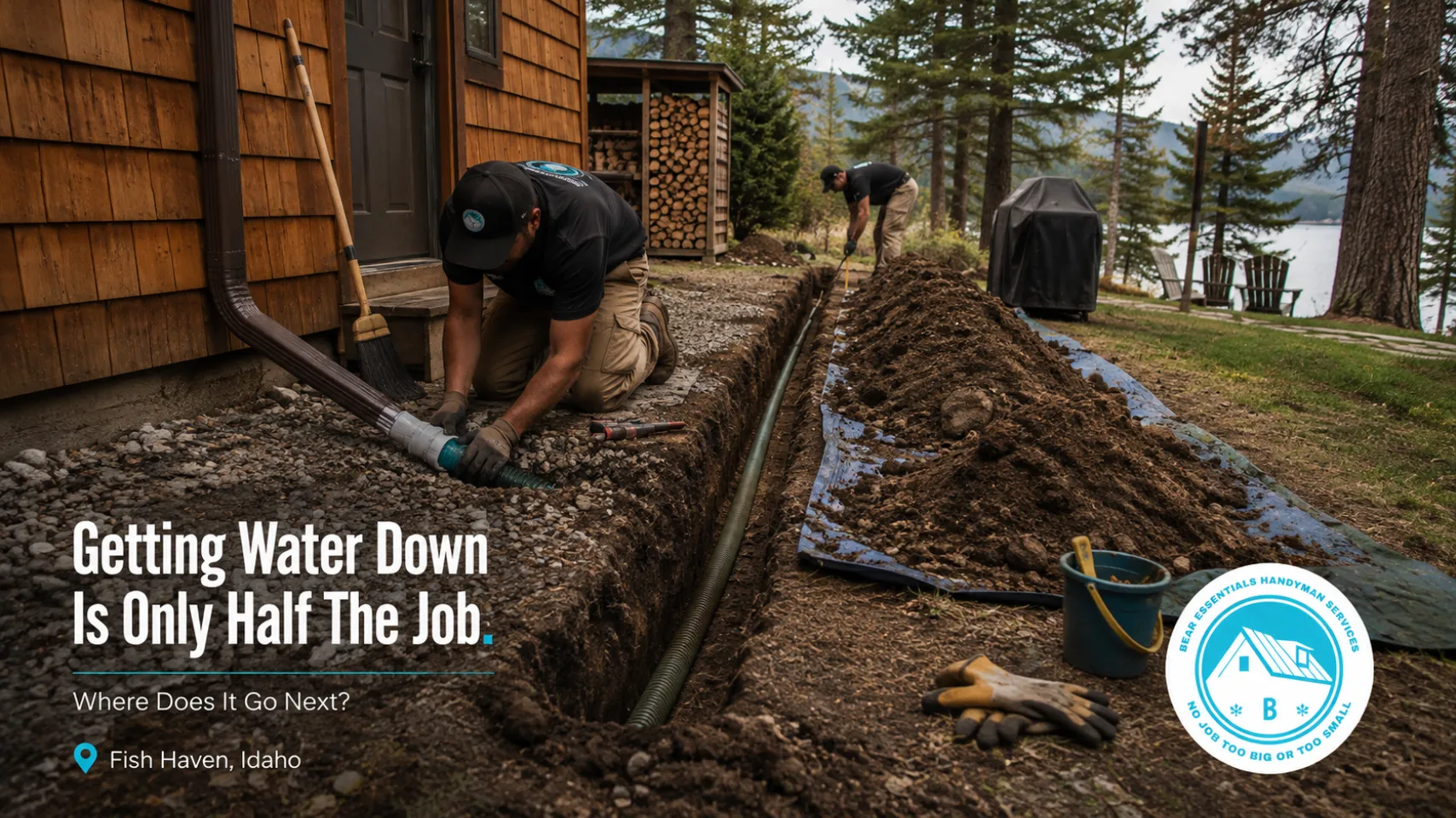
This is one of the most useful questions a cabin owner can ask.
A downspout that successfully carries water from the roof to the ground has completed only part of the job. DOE guidance recommends carrying downspout water to appropriate sloping grade away from the foundation or to an appropriately designed drainage system. Its building-science guidance specifically describes downspout extensions, underground catchment systems and other drainage approaches as ways of keeping concentrated roof runoff away from foundations.
That doesn’t mean every Bear Lake property needs the same extension length, underground pipe or drainage design. Site conditions differ, and local requirements or physical constraints can affect the appropriate solution. What matters during your initial walkthrough is whether you can follow the water from the downspout outlet and understand where it goes next.
If the answer is “right beside the cabin, and then nowhere”, that’s worth evaluating.
Can the Ground Around My Cabin Be Part of the Problem?
Yes. The surrounding grade is an important part of water management.
DOE guidance for residential construction calls for final grade to slope away from the foundation so surface water drains away from the building rather than toward it. Where there isn’t enough space to establish appropriate grade, the guidance discusses swales or drains designed to transport water away.
For an existing cabin, you don’t need to stand outside with surveying equipment and diagnose the property yourself. Look for ordinary clues. Has soil settled beside the cabin? Is there an obvious depression? Does water repeatedly follow the same route? Has landscaping created a low spot? Does runoff from an uphill area arrive at the cabin before continuing elsewhere?
The important distinction is that gutters manage roof water, while grading helps manage what happens once water reaches the ground. Looking at one without the other can miss the larger drainage pattern.
Why Is Water Cutting Across My Gravel Driveway?
A gravel driveway can reveal where runoff wants to travel.
After rainfall, you may notice small channels, relocated gravel, sediment deposited farther downhill, or one section that repeatedly becomes wet. That doesn’t automatically mean the driveway needs excavation or a drainage system. It means water is moving through that area, and the pattern can help identify where the flow originates and where it continues.
EPA stormwater guidance explains that runoff moves across roofs, roads, parking areas and other surfaces rather than infiltrating where surfaces are impervious or compacted. Runoff can also carry sediment as it moves. On a cabin property, the useful question becomes whether driveway runoff is staying within a reasonable drainage route or being redirected toward the cabin, neighboring areas or another place where it shouldn’t accumulate.
This is also why repeatedly adding gravel without understanding why the same area washes out may address the appearance without addressing the water route.
Can Landscaping Change How Water Moves Around a Cabin?

Landscaping and drainage are connected because changes to the ground surface can change how water travels.
A newly created planting bed, accumulated soil, edging, compacted traffic areas, landscape rock or changes in vegetation can influence local surface flow. That doesn’t mean landscaping is automatically responsible whenever water pools. It means landscaping should be considered as part of the surrounding site rather than treated as completely separate from drainage.
EPA describes approaches such as vegetated areas and rain gardens that intentionally slow, collect or infiltrate stormwater, demonstrating that landscape design can be used as part of water management when it is appropriately planned.
For a Bear Lake cabin owner, the practical approach is simpler: if water started appearing after the surrounding ground or landscaping changed, include those changes when evaluating the drainage path.
What If Water Is Collecting Right Beside the Foundation?
This deserves attention because prolonged water saturation immediately around a foundation isn’t something to ignore.
DOE building-science guidance explains that high volumes of roof runoff that aren’t drained away can saturate soil around a building. Proper water-management strategies include gutters and downspouts, appropriate grading, foundation drainage and other measures intended to prevent water from accumulating against the structure.
However, water beside a foundation does not automatically tell you whether the cause is the gutter, downspout, grade, subsurface drainage, another water source or some combination of conditions. If you’re also seeing moisture inside a basement or crawlspace, visible material deterioration, repeated water accumulation, or another condition that suggests the issue extends beyond routine exterior maintenance, further professional evaluation may be appropriate.
The goal is not to guess at the cause. It’s to stop treating the puddle as an isolated object and understand the path feeding it.
Do I Need Gutter Repair, Drainage Work, or Grading?
Sometimes the answer becomes obvious once the water path is observed. Other properties need closer evaluation.
Here’s the distinction I’d use before deciding what kind of project to schedule:
This is why a symptom-first approach is useful. “Water is pooling here” is a better starting point than deciding in advance that you need a new gutter, French drain, grading work or another specific solution.
What Can You Learn by Looking During the Next Storm?
Quite a lot, provided you can observe safely from the ground or from inside the cabin.
A dry-weather inspection can show disconnected downspouts, obvious low spots and erosion. Rain can reveal something different: the active route. You may see where water leaves the roof, whether the gutter captures it, where the downspout discharges, how water crosses the ground, and where it eventually slows or collects.
Take photos or short videos from safe locations if the condition is intermittent. That documentation can be useful when discussing the problem later, especially for a seasonal cabin where the owner may not be present during the next rainfall.
Do not climb onto a wet roof, ladder or unstable slope to investigate stormwater. The purpose is observation, not putting yourself in a hazardous position to identify a problem.
A Real Fish Haven Project Shows Why the Whole Water Path Matters
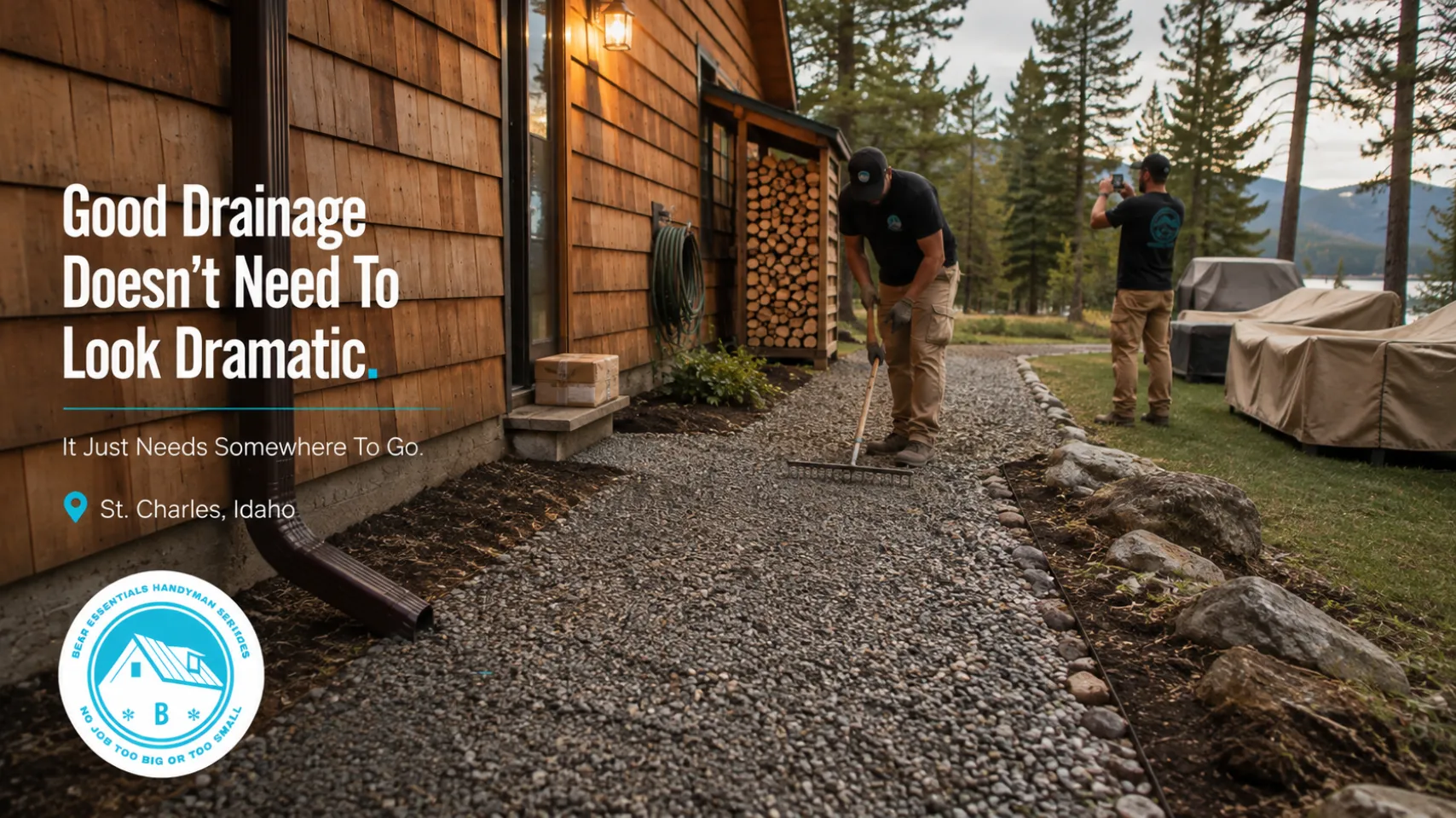
One Bear Lake Services customer in Bear Lake West/Fish Haven, Idaho, Carter Williamson, described a project that involved several parts of the property rather than one isolated repair. His Google review mentions lot mowing, weeding, retaining walls, rock landscaping, driveway rock and other property work. It also includes one particularly relevant detail:
“Buried and re-routed downspouts from my gutters and drain tile.”
That is useful first-party context because it illustrates exactly what this article is discussing: roof drainage can become a site-drainage project once water reaches ground level.
Carter’s project should not be treated as a prescription for every cabin. Another Bear Lake property may need something completely different, and we shouldn’t infer technical details beyond what his review actually states. What his experience does show is that gutter runoff, downspouts, driveway conditions and landscaping can all be considered within the larger property-maintenance picture.
That’s especially relevant in Fish Haven and around Bear Lake, where Bear Lake Services works on more than a single isolated trade.
What Should I Check Before the Next Storm?
You don’t need a 30-point stormwater checklist.
Walk the property once and try to answer three questions: Where does roof water leave the downspouts? Where does surface water naturally travel across the property? Where does that water eventually collect or leave the site?
If you can answer those three questions, you’ll have a much better starting point for deciding whether the issue appears related to gutters, downspouts, surface drainage, grading, landscaping, driveway conditions or something that needs more specialized evaluation.
And if you can’t tell, that’s useful information too. It means the next step should be evaluating the condition rather than buying a predetermined repair.
What If I’m Not at Bear Lake When the Water Problem Happens?
This is one of the practical difficulties of owning a seasonal cabin.
A drainage problem may be easiest to understand while it’s raining, but an out-of-state owner may arrive several days later when all that’s left is displaced gravel, sediment, a damp low spot or a stain that wasn’t there before.
Bear Lake Services works with cabin owners throughout the area on gutter and downspout repairs, drainage-related property work, landscaping, excavation, driveway and property maintenance, soffit and fascia work, and general handyman repairs. For owners who want someone local keeping an eye on the property between visits, the Monthly Emergency Contact & Property Check Program also provides scheduled property checks and written photo reports.
That doesn’t mean every puddle requires a project.
Sometimes the most valuable first step is simply having someone local notice what changed after the storm.
Frequently Asked Questions
Why does water pool beside my cabin after rain?
Possible contributors can include roof runoff, downspout discharge, surrounding grade, low areas, surface drainage routes and site conditions. Seeing standing water alone doesn’t establish the cause, so follow the water path before deciding what needs repair. DOE guidance emphasizes managing both roof runoff and surface grading to move water away from buildings.
Should downspouts drain next to the foundation?
Building-science guidance recommends directing roof runoff away from the foundation rather than allowing concentrated water to saturate soil immediately beside the building. The appropriate method depends on site conditions and may involve surface discharge to suitable grade or an appropriately designed drainage system.
Why does gravel keep washing out of my driveway?
Repeated gravel movement can indicate that surface runoff is traveling through that area. The cause and appropriate solution depend on the site’s slope, drainage route, surface condition and where the water originates, so repeatedly replacing displaced gravel doesn’t necessarily address the underlying water path.
Can landscaping cause drainage problems?
Changes to grading, soil, landscape features and drainage routes can influence how surface water moves. Landscaping can also be intentionally designed to manage stormwater, so the effect depends on the individual property and design.
Should I watch my gutters during a storm?
Observing safely from the ground or inside can help show whether roof water enters the gutter, where it leaves the downspout and where it travels afterward. Do not climb onto wet roofs or ladders to investigate drainage during a storm.
Does standing water mean I need a French drain?
No. Standing water is a symptom, not a diagnosis. The appropriate solution depends on where the water originates, site grading, soil and surface conditions, existing drainage and where runoff can appropriately be directed.
Sources
U.S. Department of Energy — Foundation Drains, Gutters & Downspouts
U.S. Department of Energy — Final Grade Slopes Away From Foundation
U.S. Department of Energy — Stormwater, Gutters & Downspouts
U.S. EPA — Urbanization and Stormwater Runoff
U.S. EPA — Sources and Solutions: Stormwater