

28 Oct What Causes Ice Dams on Cabin Roofs and What Bear Lake Owners Should Watch For
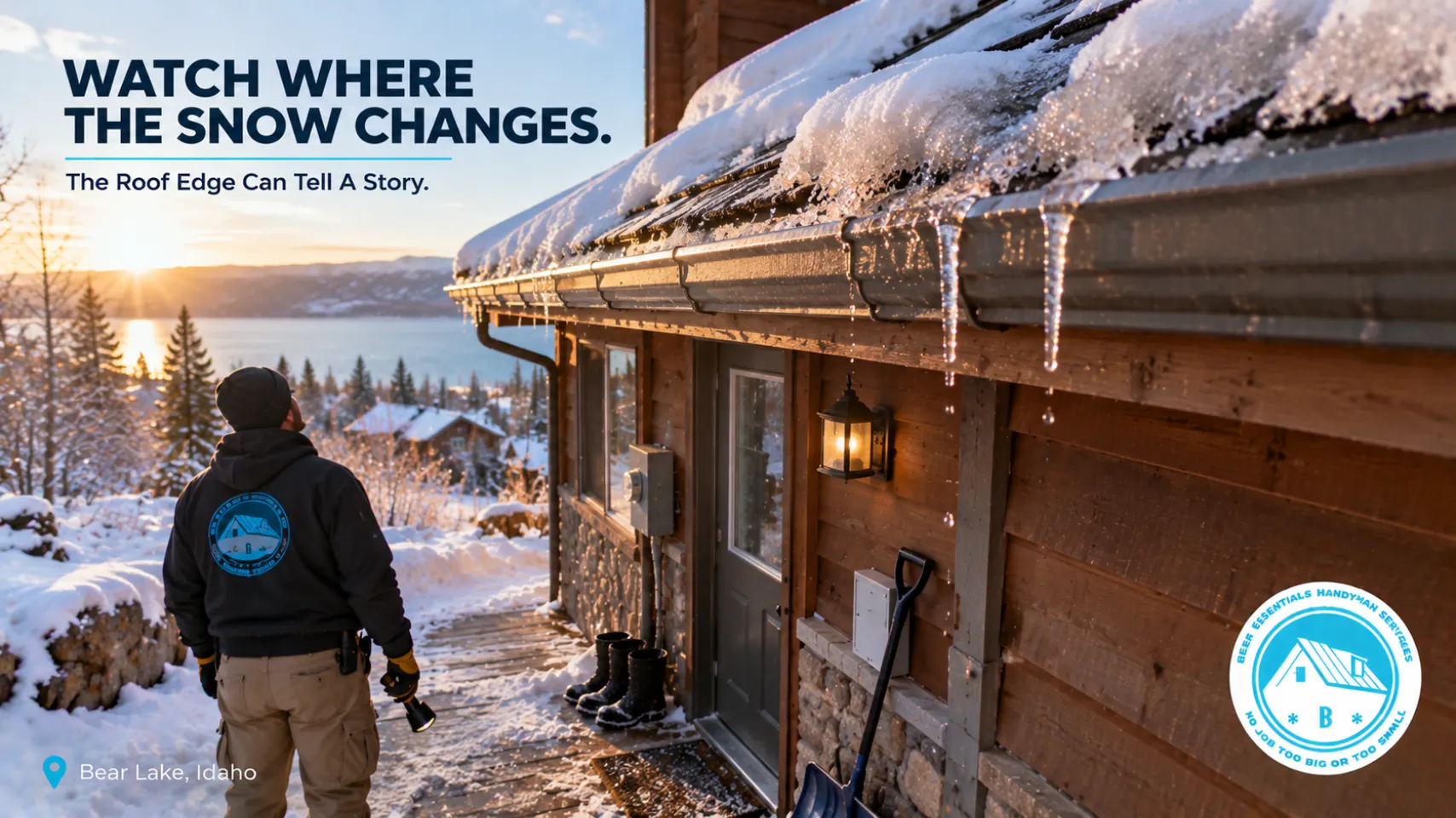
When you get to your cabin at Bear Lake, you see a thick ridge of ice stretching along the lower edge of the roof. There could be long icicles dangling from the eaves. Snow is still covering the higher part of the roof, and elsewhere, from the ground, everything else looks normal.
It’s possible that the ice is not just precipitation that has frozen on the roof.
An ice dam is formed when snow melts on a warmer part of the roof, flows down, and then refreezes as it reaches a colder area close to the edge of the roof. Whenever this process occurs repeatedly, ice can accumulate to form a ridge that stops later meltwater from draining as it should. Water may then gather behind the ice and might even act underneath the roof covering. Both the Building Science Education program of the U.S. Department of Energy and the University of Minnesota Extension give this same basic explanation of the freeze-melt-refreeze mechanism.
For seasonal cabin owners living around Bear Lake, it is useful to understand that process since carrying out ice dam removal, clearing snow from the roof and carrying out long-term winter maintenance of the roof address related but not identical problems.
What is an ice dam exactly?
An ice dam is a ridge of ice which forms close to the lower part or edge of a roof that is covered with snow and prevents the draining of meltwater.
The process typically starts somewhere higher up on the roof. When heat reaches the roof deck it warms a section of the roof sufficiently to melt the under side of the snowpack. The water then moves downwards either beneath or through the snow until it gets to a colder area of the roof—often the eave, since there is usually little or no heated building space directly underneath.
The water freezes there.
More meltwater reaches that area, refreezes and thus gradually increases the amount of ice. In the end, liquid water can gather up behind that frozen barrier.
That is why the ice which can be seen at the edge of the roof is only part of the story.
What causes ice dams to form on some roofs?
The fundamental problem is that the surface of the roof has uneven temperatures.
The University of Minnesota Extension states that for an ice dam to form there must be snow on the roof and the upper part of the roof surface has to be warm enough for the snow to melt while the lower part remains below freezing; heat escaping from the building is a major cause of these temperature differences.
The Energy Department also states that heat from the attic can cause snow on the roof to melt, after which the melted snow flows towards the colder eaves and refreezes.
Several different conditions may cause the heat to reach the roof assembly.
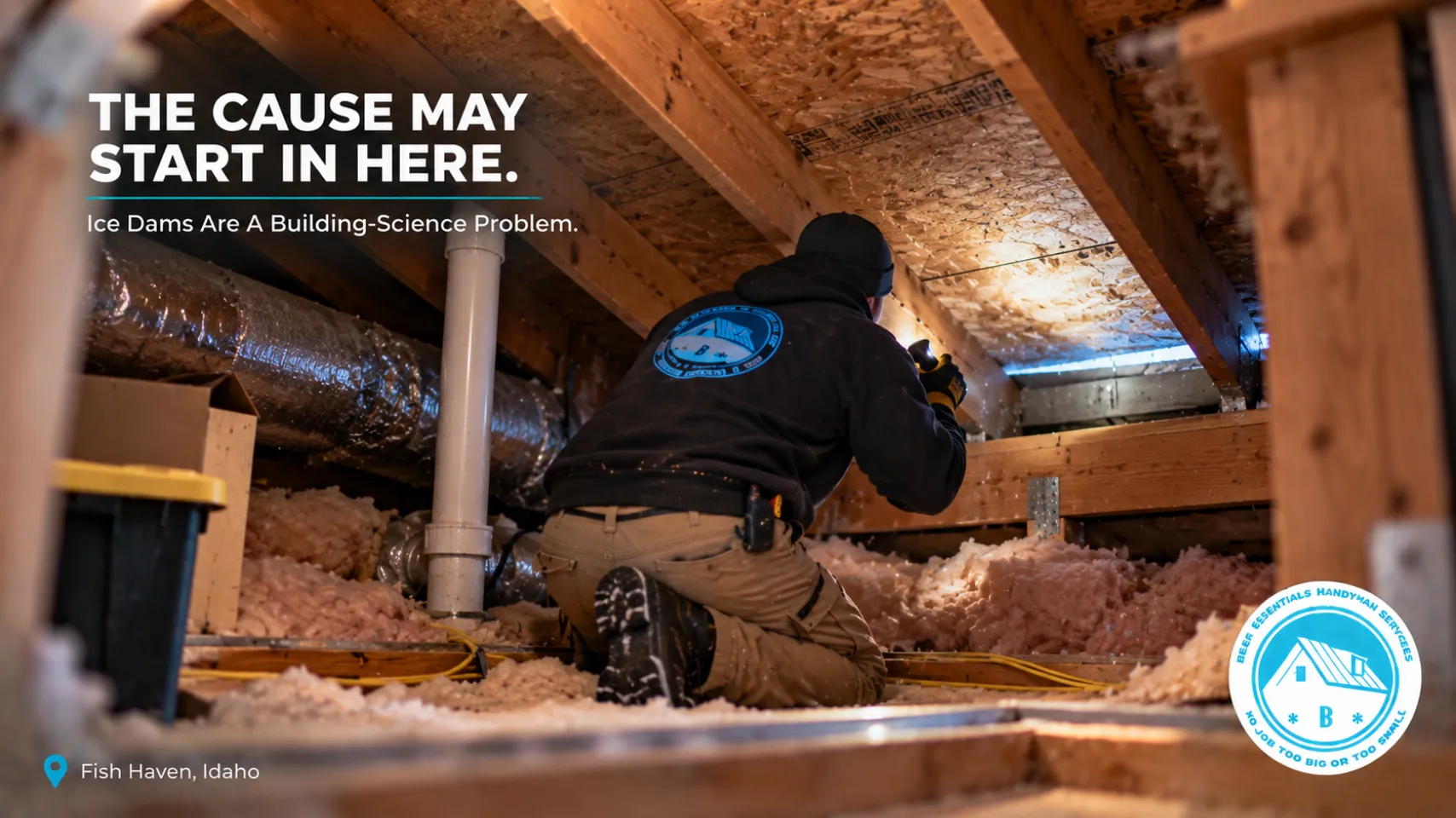
Building Science Corporation names ceiling air leakage, plumbing stacks, recessed lights, chimneys, electrical penetrations and attic hatches as possible causes of roof warming and ice damming.
For people who own cabins this is a point of importance since the ice that is visible outside can be related to the conditions inside the building envelope.
Is the same thing an icicle and an ice dam?
No.
An icicle is ice that is hanging. An ice dam is a build-up of ice on the roof which blocks the drainage of meltwater.
You can tell that melting and refreezing are taking place somewhere near the edge of the roof if there is considerable icicle formation. According to guidance from the Department of Energy, icicles are a visible sign that melting is occurring on a roof that is covered with snow.
It doesn’t follow that each small icicle shows that water is getting into the cabin or that the roof needs emergency repair.
What is important is the overall pattern.
It should be looked at if there is a great deal of ice forming along the eave while snow still remains higher on the roof, especially when the ice keeps on growing as a result of freeze-thaw cycles.
How does an ice dam appear from the ground?
People who own cabins should focus on noticing the changes rather than attempting to judge the whole roof based on a single photograph.
You could observe a continuous or irregular ridge of ice by the eaves, a rather large number of icicles, a concentration of ice beneath a certain part of the roof, or snow vanishing from some areas of the roof while it still remains on other areas.
In the cabin, any new staining of water or moisture close to the ceilings or to the exterior walls should also be investigated. As the University of Minnesota Extension points out, water trapped by an ice dam may find openings in the roof covering and enter the attic, the walls or the ceiling assembly.
It is important that the whole ice dam cannot always be seen from the ground since snow can hide parts of the ice and the water behind it.
That doesn’t mean a neat roofline proves that all parts of a snow-covered roof are behaving normally.
What is the reason that water is able to move under the roof covering?
Mainly the roofs are constructed to allow water to run down.
An ice dam disrupts that drainage path.
If meltwater from the frozen ridge is blocked, the water will stay above the ridge rather than running off the roof. According to guidance on building science from the DOE, this water which has built up can get caught between the shingles and pass through the underlayment of the roof, eventually getting to the attic.
That is also the reason why roof construction in modern cold climates usually provides extra protection close to the eaves.
The Building Science Education guidance from DOE suggests that in cold climates a self-sealing membrane should be used at the roof eaves in order to help guard against water intrusion caused by ice dams; this membrane projects inwards from the edge of the roof so that there is an additional water-control layer under the roof covering in the vulnerable eave area.
The membrane helps to cope with the effects of water backing up, but it does not remove the conditions in the building which cause the snow to melt and then refreeze.
Does the presence of an ice dam indicate that the roof is leaking?
Not automatically.
An ice dam results in situations where meltwater is able to back up rather than draining as it should, which in turn increases the chance of water getting in through the openings in the roof assembly.
Whether or not water gets into a specific cabin is determined by the roof assembly, the underlayment, the flashing, the condition of the roofing and other construction details.
The importance of this distinction lies in the fact that homeowners often see ice and then suppose that water is already in the building.
Instead, look for evidence.
If the ceiling has stained, the insulation is damp, there is visible moisture in the attic or water appears around the external walls, then an investigation is needed. When you are not at the cabin, a local property inspection can be very useful since you can’t see the interior conditions from a weather app or an exterior camera.
Is roof snow the same issue as an ice dam?
Not so much—this is indeed one of the most important distinctions in this winter series.
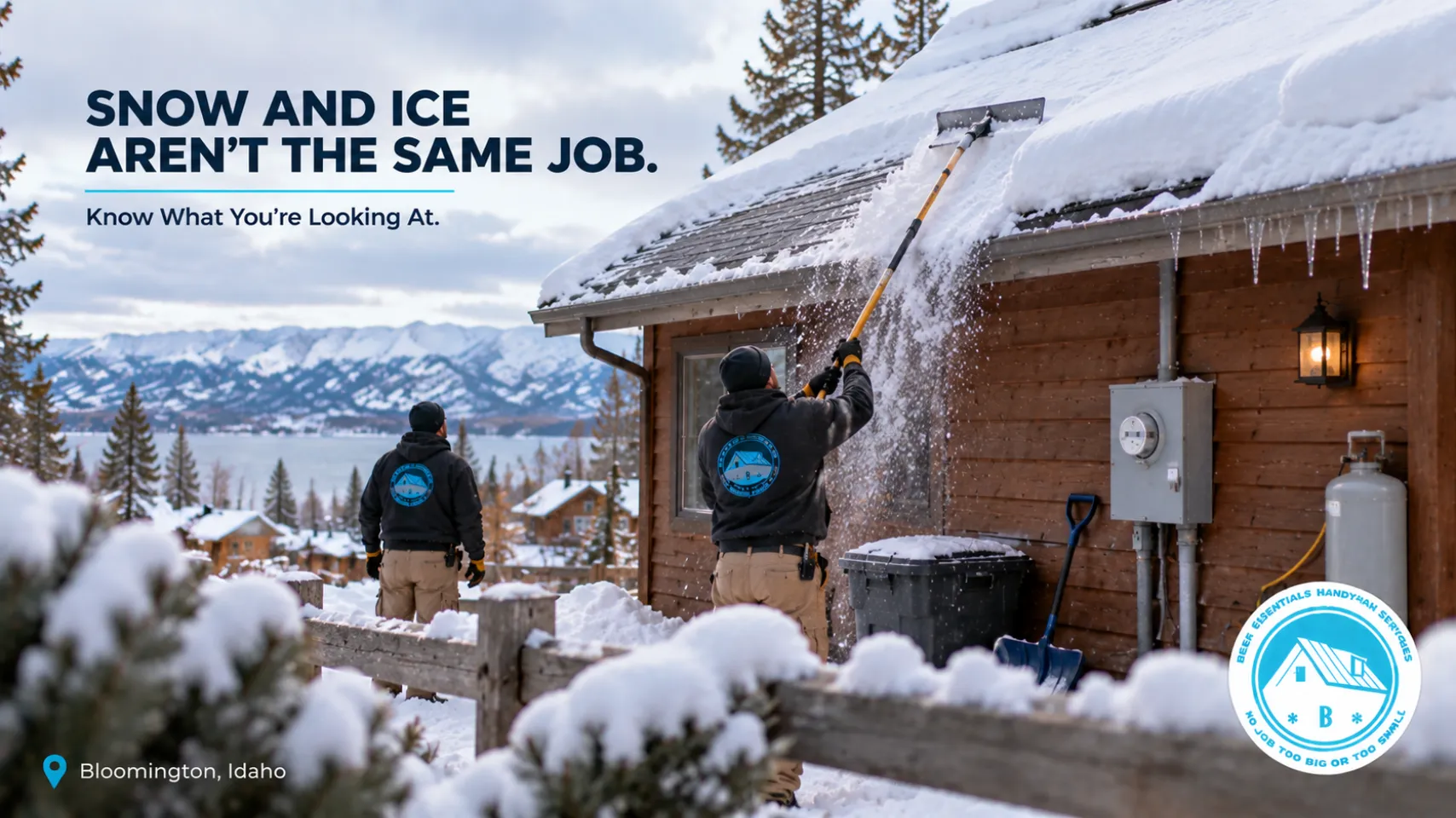
The clearing of snow from roofs involves the snow that has accumulated on them.
The removal of ice dams involves dealing with ice that is blocking the normal drainage of meltwater around parts of the roof.
A considerable amount of snow may be on a roof even if there is no visible ice dam, and a roof can have an ice dam even if the total snow load is not high.
The weight of snow is not determined simply by its depth but by weight. OSHA points out that the weight of snow depends on its water content and may be influenced by melting, refreezing and drifting; the amount that a given roof can bear is determined by its design and condition.
That is the reason why roof snow removal and ice dam removal should not be regarded as interchangeable search terms or as interchangeable services.
Can removing snow from the roof help with ice dams?
By removing the snow, one of the components required for the ongoing formation of an ice dam—is eliminated, namely the snow that can melt.
The University of Minnesota Extension regards roof-snow removal as one of its short-term ice-dam control measures.
That doesn’t imply that getting rid of the snow will deal with the fundamental cause.
If the heat still reaches the roof deck in an uneven manner, the conditions which led to the ice dam could come back should more snow accumulate.
Since the problem is one that occurs repeatedly, the building might require some attention.
Why is it important to have air sealed and insulated?
It is here that ice dams turn into a building-science issue rather than just a problem concerning the removal of snow.
The object in a conventional vented attic is to reduce the amount of heat that transfers from the living area into the attic and roof structure.
The DOE’s guidance suggests that good air sealing at the ceiling plane or roof deck, sufficient attic insulation and the use of appropriate ventilation should be regarded as measures capable of reducing or mitigating roof-deck warming and the resulting formation of ice dams.
It’s important to focus on air sealing since insulation and air leakage are completely different.
Warm indoor air is capable of passing through the gaps found around the attic hatches, through the plumbing and electrical penetrations, the light fixtures and all the other openings. The Building Science Corporation states that this air may go around the thermal insulation and directly heat the attic or the underside of the roof.
Therefore DOE advises that when insulation is being added to existing vented attics the attic-floor penetrations should be sealed.
It doesn’t follow that more insulation alone is the full solution if warm air can still get around it.
Does proper attic ventilation help to prevent ice dams?
Ventilation can be an important element of a well-designed vented roof assembly, but the idea of ‘just adding more ventilation’ is too simplistic an approach to the problem.
The DOE guidelines regard air sealing, insulation and ventilation as components of the roof/attic strategy; in the case of vented attics, baffles are able to maintain the airflow from the soffit vents at the same time as they help ensure that the insulation remains in position close to the eaves.
The right method will vary according to the roof assembly.
Certain roofs have vents while other roofs are constructed as unvented assemblies and cathedral ceilings as well as the upper floors that are finished may also differ from a plain open attic.
With respect to a cabin that already has recurring ice dams, the appropriate question to ask is not just whether or not a roof vent is visible from the outside. The entire thermal and air-control system must be taken into account.
Why does one section of a cabin’s roof tend to ice up more than another?
Heat is not always distributed in a uniform manner throughout a building.
A section can be positioned above a warmer living area, while another can be above an unconditioned porch. The chimney might go through one of the roof sections and an attic hatch or duct may be situated underneath another.
The Building Science Corporation points out that plumbing stacks, recessed lights, chimneys, electrical penetrations, attic hatches and attic ductwork are all capable of creating local air or heat paths.
Roof geometry matters too.
The presence of valleys, dormers, overhangs and transitions results in varied drainage and temperature conditions. The DOE considers valleys and penetrations to be especially susceptible places for water entering and suggests particular membrane and flashing details for these positions.
Therefore, the fact that one section forms ice repeatedly while another does not can be of use as information.
Should you take it upon yourself to break up an ice dam on the roof?
Caution is important here.
A roof covered with snow and ice presents a dangerous working environment, since OSHA has identified falls as the main cause of deaths and serious injuries during snow-removal operations on roofs and advises that snow-removal methods be used which avoid having workers go onto the roofs when possible.
Snow and ice may also conceal the edges of roofs, skylights and other dangers. If the distribution of the snow is altered incorrectly, unbalanced loading will result, which is another reason why roof work should not be treated as simply involving climbing up with a shovel.
There is one other practical issue, which is that if you aggressively hit or chop ice it can damage the roofing materials beneath it.
If it is not safe to deal with the condition from below using the right method—or if the ice is widespread, the roof is steep, the state of the building is unclear, or water infiltration is already taking place—then it is better to have a professional assessment.
What About Roof Rakes?
A roof rake enables a certain amount of snow to be removed from ground level and thus obviates the need for a person to go directly onto the roof.
It must still be used with care.
The University of Minnesota Extension states that roof rakes and push brooms can be used for removing snow but might cause damage to the roofing materials.
The aim must instead be to target the roofing surface.
All the factors such as the material of the roof, the slope of the roof, the state of the snow, access, the neighbouring property, and the instructions from the manufacturer are important; a tool that is suitable for one property might not be suitable for another.
Should you use salt or ice melt on your roof?
It would be a mistake to think that a product suitable for use on a driveway can also be used on a roof.
The things that are placed above roofing materials, fasteners, gutters, downspouts, siding and landscaping can all have an effect on them, and the products also vary chemically with different instructions from the manufacturers.
That is why the article will not suggest a universal household deicer for the removal of ice dams in Bear Lake.
The method you should use for removal will vary according to the type of roof and the real state of the ice. If you are unsure, then you should first determine the material of the roof and either follow the guidance given by the manufacturer or have a qualified service provider carry out the work rather than trying out an unknown product.
What should the owners of Bear Lake cabins keep an eye out for during the winter?
There is no need for you to diagnose building science from the driveway.
You have to notice when there is a change.
Following a fall of snow and after some freezing periods, check the way the snow is acting on the roof; observe if one area is melting much faster than another, if ice is forming again and again along the same eave, if the icicles are getting longer, and if there is any water staining or moisture inside the house.
In a cabin that is occupied, such changes might be noticeable.
For a person who is not from the area, the houses are more difficult to spot.
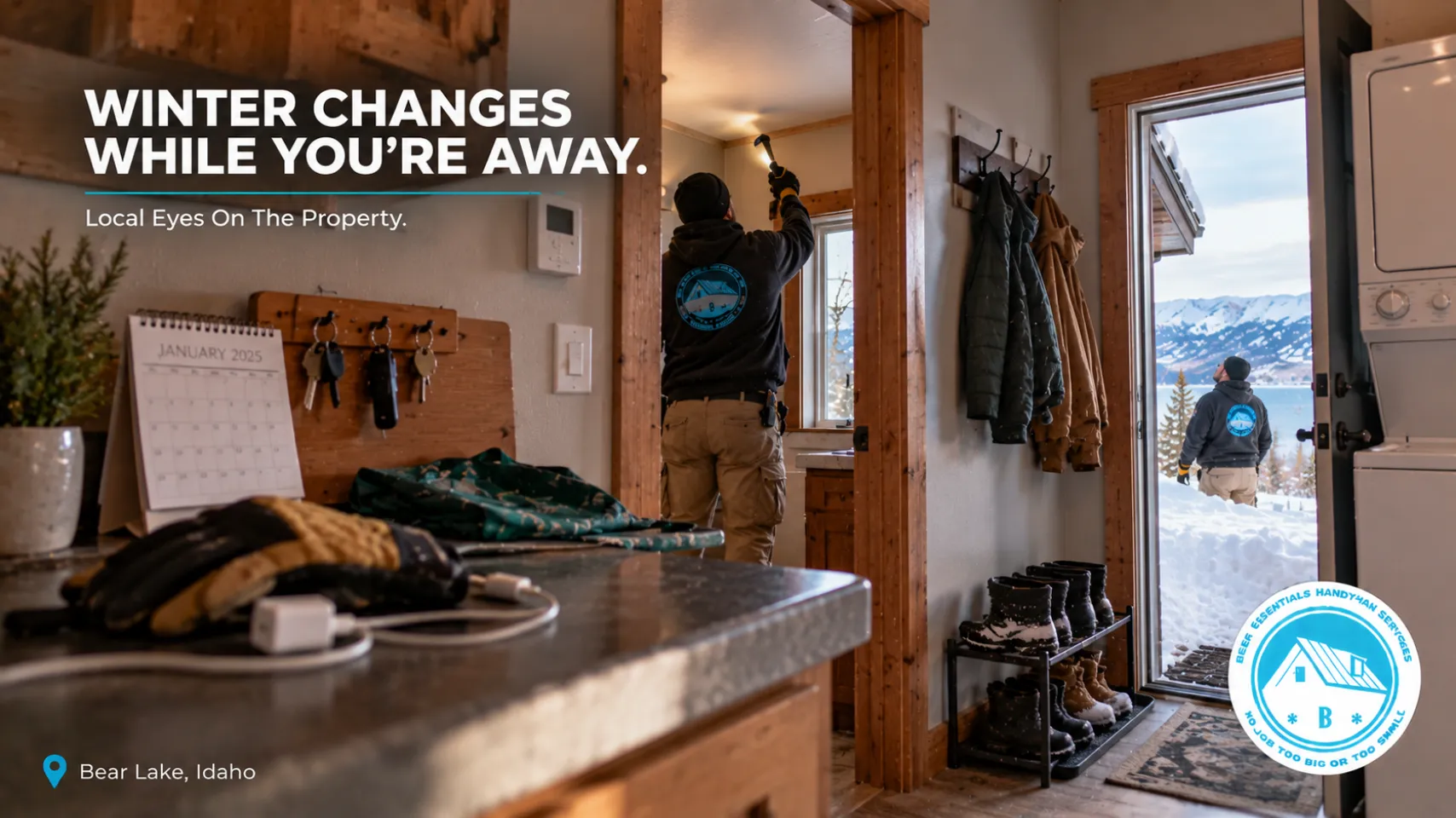
The Bear Essentials Handyman Services Monthly Emergency Contact and Property Check program currently involves planned visits to the property, exterior and interior inspections, evaluations of any visible repairs and maintenance, and the production of written reports together with photographs. The program is offered in Garden City, Laketown, Fish Haven, St. Charles and Bloomington.
It doesn’t turn a simple property check into a roof engineering inspection, but it does allow remote owners to obtain up-to-date, local observations regarding a property of which they are not physically present.
What would happen if my cabin developed ice dams each winter?
More attention should be paid to the formation of ice-dams than to repeatedly removing the visible ice.
The fact that this pattern is recurring could be a sign that heat is causing certain parts of the roof deck to melt and then refreeze repeatedly.
Things worth investigating could be air leakage, the continuity of the insulation, the attic’s arrangement, ventilation where suitable, penetrations, ducts and local heat sources. Specifically, according to DOE guidance, properly sealed and insulated attics are linked to a reduction in ice-dam formation.
It doesn’t follow that all ice dams which recur have the same repair.
An attic with a simple venting arrangement, together with a cathedral ceiling and a finished half-story roof, may call for quite different methods. One should establish the cause before suggesting a solution involving the building envelope.
Ice Dam Removal vs. Long-Term Prevention
It is particularly important for people who own their homes when they are looking at winter services.
The removal of the ice deals with the ice that is currently there.
Prevention in the long term could include fixing the conditions in the roof or attic assembly which lead to repeated melting and refreezing.
To treat them as two separate questions stops homeowners from expecting a temporary winter service to provide a permanent solution to a building-envelope problem.
At what time should you have your roof examined?
It would be worth having the situation assessed if ice keeps accumulating along an eave, if the same part of the roof repeatedly forms ice dams, if there is water staining inside the building, if the roofing or flashing is already known to be damaged, or if you are uncertain whether the problem is mainly due to ice, snow buildup or an existing condition of the roof.
Bear Essentials Handyman Services includes among the services it provides for Bear Lake snow removal, ice dam removal, roofing, gutter cleaning and seasonal property care.
When asking for a service visit, seasonal owners should give as much information as they can including the location of the cabin, the type of roof if this is known, where the ice can be seen, whether there has been any interior moisture, whether or not the cabin is occupied, and any existing roof problems.
It thus becomes easier to tell what sort of visit the property actually requires.
Ice Dam Removal in Bear Lake: Understand the Cause Before Winter Repeats It
The visible ridge of ice is the final outcome of the process taking place over the roof.
On some part of the roof the snow melts, the water then flows to a colder area where it freezes, and as this process is repeated ice builds up. When the frozen ridge starts to prevent further meltwater from running off, the roof could end up being exposed to water in areas for which it was originally intended to shed the water.
That means that there are two distinct jobs for people who own a cabin at Bear Lake.
The first option is to deal properly with the snow or ice that is already present.
The second point—especially in the case where the problem reoccurs—is to work out why that part of the roof continually creates the conditions which lead to an ice dam.
The difference between reacting to winter and understanding what your cabin is trying to tell you is that.
Frequently Asked Questions
What leads to an ice dam forming on a roof?
Ice dams generally occur when the snow melts on a warmer section of the roof, then flows down and refreezes in a colder area close to the eave. If melting continues, the frozen ridge will grow larger and water will collect behind it.
Does the presence of icicles mean that I have an ice dam?
It doesn’t have to. While icicles indicate that melting and refreezing are taking place, an ice dam refers to ice which blocks the drainage of meltwater from the roof. Therefore, the presence of large or frequent icicles may be a reason to investigate the condition of the roof.
Can bad insulation lead to ice dams?
Poor or inconsistent insulation can have the effect of permitting heat to get to the roof deck, and air leakage can as well go around the insulation, which is why DOE building-science advice places emphasis on both air sealing and insulation as well as on proper ventilation for vented assemblies.
Will removing the snow stop ice dams?
Getting rid of snow on the roof removes the snow that could melt and may therefore serve as a temporary control measure. However, it does not necessarily remedy the heat-transfer or air-leakage conditions which are responsible for the recurrence of ice dams.
Is the process of removing snow from roofs the same as removing ice dams?
Number one, roof snow removal is concerned with the snow that has accumulated. Ice dam removal looks at the ice build-up which is preventing the meltwater from draining. A property may need one without at the same time needing the other.
Shall I go on to the roof of my cabin and take the ice off myself?
Roofs covered with snow or ice pose serious dangers regarding falls and to the structure itself. OSHA advises that care should be taken when carrying out work to remove snow from roofs and that methods should be used which keep the workers off the roofs if possible.
May Bear Lake Services carry out a inspection of my cabin while I am away?
Yes. The company’s Monthly Emergency Contact & Property Check Program currently offers scheduled visits, interior and exterior walkarounds, visible maintenance assessments and written photo reports for properties in Garden City, Laketown, Fish Haven, St. Charles and Bloomington.
References
U.S. Department of Energy — Building Science Education: Eaves Sealed in Cold Climates
Explains the melt-flow-refreeze mechanism behind ice dams and the roles of air sealing, insulation and ventilation.
University of Minnesota Extension — Dealing With and Preventing Ice Dams
Detailed explanation of roof-temperature differences, snowmelt, ice-dam formation and short- and long-term control.
U.S. Department of Energy — Air Sealing Existing Attics
Explains why attic-floor penetrations should be air sealed and how air sealing complements insulation.
U.S. Department of Energy — Blown Insulation in Existing Attics
Discusses attic insulation, air sealing and ice-dam prevention.
U.S. Department of Energy — Installing Self-Sealing Membrane at Eaves
Explains cold-climate eave protection against water intrusion associated with ice dams.
U.S. Department of Energy — Baffles
Explains the role of baffles and airflow in vented attic assemblies.
Building Science Corporation — BSD-135: Ice Dams
Technical discussion of air leakage, heat transfer and common building penetrations associated with ice-dam formation.
U.S. Department of Energy — Building America: Preventing Ice Dams
Building-envelope guidance covering roof-deck temperature, air sealing and insulation.
OSHA — Falls and Other Hazards to Workers Removing Snow From Rooftops and Other Elevated Surfaces
Federal workplace guidance on falls, structural loading and safe roof-snow removal practices.
OSHA — Snow Removal: Know the Hazards
Additional federal safety guidance for roof and elevated-surface snow removal.
Bear Lake Handyman Services — Monthly Property Check & Emergency Contact Program
Current program information for remote and seasonal Bear Lake property owners.
Bear Lake Handyman Services — Bear Lake Property Services
Current first-party service information, including roofing, snow removal, ice dams and seasonal property care.