


03 Sep Is Your Bear Lake Cabin Ready for Fall? A Practical September Property Walkthrough
Written by Stu, Lead Technician at Bear Lake Services, serving Bear Lake, Fish Haven, Bloomington, Garden City, and surrounding communities with handyman services, property maintenance, seasonal care, repairs, and property improvements.
September at a Bear Lake cabin doesn’t necessarily mean it’s time to shut everything down for winter.
There may still be weekends at the lake, outdoor projects to finish, guests coming and going, and plenty of time spent outside.
But September is a useful time to look at the property differently.
Instead of asking: “What do I need to winterize?”
ask: “What changed around the cabin during a busy summer?”
A driveway that looked fine in May may now have washed-out areas. Vegetation may have grown around equipment or structures. A deck may have developed a loose board. Screens may have been damaged. A gutter connection may have shifted. Inside, a slow plumbing leak or door that no longer closes properly may have gone unnoticed during a summer filled with guests, lake days and weekend arrivals.
The point of a September property walkthrough isn’t to diagnose every building system yourself.
It’s to notice what changed, what deserves attention, and what can simply be monitored.
For owners in Bear Lake, Fish Haven, Bloomington, Garden City and surrounding communities, here’s a practical way to do it.
Where Should I Start?
Don’t start with a giant checklist.
Start where you arrive.
Stand near the driveway and look at the property as though you haven’t seen it all summer.
Then walk toward the cabin slowly.
A useful route is:
Driveway → lot → deck and stairs → exterior walls → windows and screens → gutters and roof edge → outdoor HVAC equipment → interior → plumbing → doors and locks
That order matters less than being consistent.
You’re looking for changes, not trying to conduct a professional home inspection.
Your September Walkthrough at a Glance
Has the Driveway Changed Since Spring?
This is easy to overlook because you’re driving over it every weekend.
Walk it instead.
Look for displaced gravel, rutting, erosion, low areas or places where runoff appears to be taking a new route.
The important issue isn’t whether the driveway looks perfectly smooth.
It’s water movement.
The U.S. Department of Energy’s Building Science Education program emphasizes that grading and drainage should move stormwater away from a home’s foundation. Water that repeatedly saturates soil around a building can contribute to moisture and durability problems.
So if you’re seeing erosion or a new channel developing, ask:
Where is this water coming from? Where is it going next?
That makes the driveway part of the property’s drainage system rather than merely a cosmetic landscaping feature.
Did the Lot Get More Overgrown Than You Realized?
Probably one of the easiest changes to underestimate during summer is vegetation growth.
Walk around the cabin rather than looking at the lot from the deck.
Check vegetation around:
exterior walls;
HVAC equipment;
pathways;
decks and stairs;
utility areas;
drainage paths;
driveway edges.
This doesn’t mean every weed needs to disappear.
The question is whether vegetation is interfering with access, equipment, drainage, visibility or the building itself.
EPA integrated pest-management guidance also recommends managing vegetation near structures and repairing exterior openings as part of reducing pest entry opportunities.
If your property needs more than basic trimming, this is where lot clearing, landscaping, tree work or property maintenance may become part of the September project list.
Does the Deck Feel Different Than It Did in May?
Don’t just look at the stain.
Walk the deck.
Use the stairs.
Hold the railing normally.
Pay attention to whether anything feels different.
Exterior wood experiences moisture, sunlight and weather exposure. USDA Forest Service research has extensively documented the effects of weathering on exterior wood and the role finishes play in protecting exposed surfaces.
What you’re looking for during your walkthrough is simpler:
Are boards visibly damaged?
Does anything move that didn’t before?
Has a railing become loose?
Are stair components secure?
Does the wood show deterioration that deserves closer evaluation?
If the only change is cosmetic fading, that’s a different decision from discovering a loose railing or damaged board.
Don’t confuse refinishing with repair.
Determine the condition first.
Then decide whether the next step is maintenance, deck staining, deck repair, or further evaluation.
Are the Siding, Soffit and Fascia Still in Good Shape?

Now step off the deck and look back at the cabin.
You don’t need binoculars or a ladder.
Look at what is safely visible from the ground.
Notice:
loose or damaged exterior trim;
changes in siding;
areas of peeling or deteriorating finish;
damaged fascia;
visible soffit problems;
open gaps;
and staining that wasn’t there earlier in the season.
The goal isn’t to diagnose hidden water intrusion from the yard.
It’s to notice a change worth investigating.
This is especially important when the visible damage appears near roof edges, gutters, windows or other places where water is managed around the building envelope.
Did Any Window or Door Screens Get Damaged This Summer?
Screens have a rough summer at busy cabins.
Windows get opened.
Doors get used constantly.
Kids, guests and pets move through the property.
So check them individually.
EPA pest-management guidance specifically recommends installing or repairing screens in exterior openings and addressing gaps around doors and windows as part of pest exclusion.
Look for: torn mesh, screens pulling away from frames, damaged frames, screen doors that no longer close properly, or missing screens.
But distinguish the screen from the window or door itself.
A torn screen is one maintenance issue.
A window that doesn’t properly close or a door that doesn’t secure is another—and generally deserves greater attention.
Are Your Gutters Still Sending Water Where You Think They Are?
This deserves more attention than simply checking whether the gutter contains leaves.
Look at the entire path: Roof → gutter → downspout → discharge point → ground
DOE building-science guidance explains that gutters and downspouts are intended to collect roof runoff and carry it away from the building. If large volumes of roof water are allowed to saturate soil immediately around a structure, moisture-related problems can result.
Look for obvious changes:
Is a gutter section pulling away?
Has a downspout disconnected?
Is water being discharged beside the cabin?
Do you see erosion below a downspout?
Is debris interfering with drainage?
Has landscaping changed the route water takes after leaving the downspout?
This is one reason gutter repair, downspout repair, drainage and grading often overlap.
The important homeowner question is not: “Does my gutter look clean?”
It’s: “Where will the next rainstorm go?”
What Can I Actually Check Around the Roof?
Keep your feet on the ground.
A September property walkthrough does not require climbing onto your cabin roof.
From a safe location, look for obvious changes around visible: roof edges, flashing areas you can see, gutters, fascia, soffits, and roof penetrations that are visible from the ground.
If something appears damaged, displaced or unusual, that’s when further evaluation makes sense.
A ground-level observation can identify a concern.
It cannot tell you the complete condition of a roofing system.
What Should I Look at Around the Outdoor AC Unit?
September is also a good opportunity to look at the area around outdoor HVAC equipment after a summer of vegetation growth and regular cooling use.
You’re not servicing the equipment yourself.
You’re looking at its surroundings.
Check for vegetation growing close to the unit, leaves, grass or debris accumulating around it, visible physical damage, and anything obviously obstructing the equipment.
If the system isn’t operating correctly, making unusual sounds or showing another operational concern, that’s different from routine property maintenance and may require qualified HVAC service.
This distinction matters throughout the walkthrough:
Observe first. Diagnose second.
A handyman/property check can identify visible conditions. Technical diagnosis of regulated or specialized systems belongs with someone qualified for that work.
What Should I Check Once I Go Inside?
Now forget about the outside for a moment.
Walk through the cabin without cleaning anything.
You’re looking for changes.
Check around: sinks, toilets, water heater areas, visible plumbing connections, windows, exterior doors, ceilings, walls, and floors near plumbing fixtures.
You’re looking for visible evidence of something that deserves attention, such as an active drip, unexplained moisture, new staining or material damage.
Don’t automatically patch a stain or repaint damaged drywall until you understand why it changed.
A cosmetic repair can hide a symptom without correcting its source.
Should I Check Every Faucet and Plumbing Fixture?
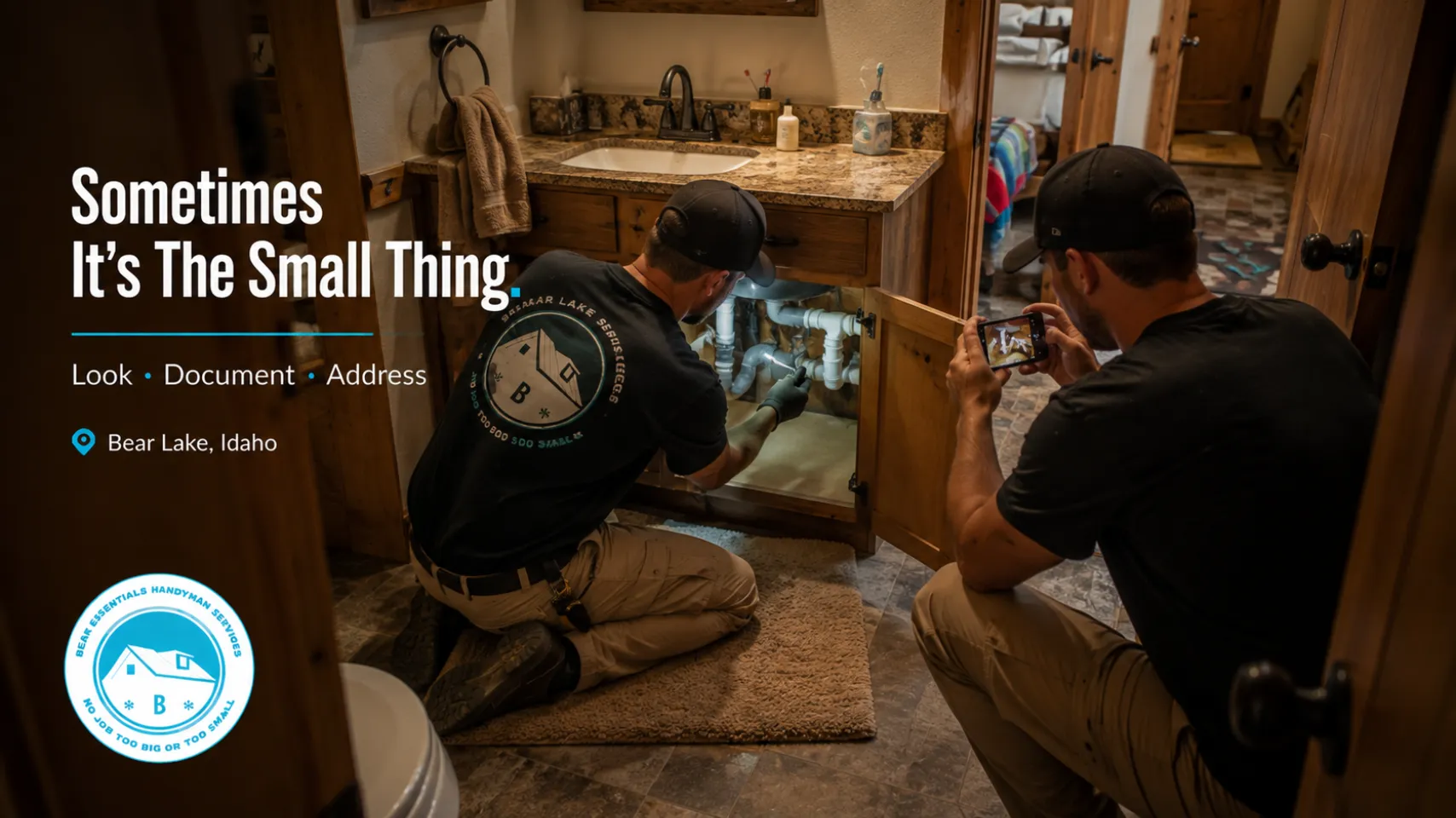
You don’t need to dismantle anything.
Simply look at accessible areas while fixtures are being used normally.
Check under sinks.
Look around toilets.
Notice exposed connections.
Look around the water heater area.
If you find active dripping or unexplained moisture, address the source rather than simply drying the area and forgetting about it.
EPA building pest-management guidance also specifically identifies fixing plumbing leaks and eliminating excessive moisture as building-maintenance measures.
Again, September isn’t yet our winterization article.
We’re simply asking: Did anything develop during summer that should be dealt with before the cabin begins sitting empty more often?
Do the Doors and Locks Still Work the Way They Should?
This may sound almost too simple to include.
But try every exterior door.
Close it. Lock it. Unlock it. Open it again.
Check whether:
the door closes normally;
the latch engages;
the lock operates;
weather stripping appears damaged;
a screen door closes properly;
or anything has loosened through repeated summer use.
EPA guidance recommends addressing gaps around doors and windows, weather stripping and exterior openings as part of building pest prevention.
For a seasonal cabin, there’s an additional practical question:
Can the property actually be secured the way you expect when nobody is there?
That’s worth knowing before your visits become less frequent.
What Needs Attention Now—and What Can Go on the Fall List?
Not everything you find during the walkthrough needs immediate repair.
Use the condition to determine priority.
The important point is that a September walkthrough should produce decisions—not panic and not a 50-item maintenance list.
What Changed Around Your Cabin This Summer?

That’s the question I’d write at the top of the list.
Not: “Is my cabin ready for winter?”
We’re not there yet.
September is the transition.
Your cabin has just come through months of visitors, outdoor use, open windows, deck traffic, landscaping growth, storms, cooling-system use and everyday wear.
Walk the property once with fresh eyes.
You may find nothing significant.
You may find five cosmetic projects.
Or you may find one issue that deserves attention more than everything else.
That’s exactly why the walkthrough is useful.
What If You Aren’t at Bear Lake Often Enough to Do This Yourself?
For owners who live outside the Bear Lake area, the challenge isn’t necessarily knowing that a cabin should be checked.
It’s being there to notice when something changes.
Bear Lake Services provides handyman and property-maintenance services throughout the Bear Lake area, including work involving decks, screens, gutters and downspouts, soffit and fascia, landscaping, HVAC-related maintenance, plumbing-related maintenance and general repairs.
Bear Lake Services also offers a Monthly Emergency Contact & Property Check Program for owners who want a local point of contact and scheduled property checks while they’re away.
The program is particularly relevant after peak summer because the property may start spending longer stretches without the owner there.
The purpose isn’t to replace a licensed home inspection or specialized trade diagnosis.
It’s much simpler: Someone local is paying attention to the property when you can’t.
Learn about Bear Lake Services’ Monthly Emergency Contact & Property Check Program
Frequently Asked Questions
What should I check around my Bear Lake cabin in September?
Walk the driveway, lot, decks and stairs, exterior walls, windows and screens, gutters and downspouts, visible roof edges, outdoor HVAC area and interior. Look specifically for changes that developed during summer rather than trying to perform a technical inspection.
Should I winterize my Bear Lake cabin in September?
This article isn’t recommending a universal September winterization date. Winterization decisions depend on the property, weather, occupancy, plumbing/heating setup and how the cabin will be used. September’s walkthrough is primarily about identifying late-summer wear and maintenance needs before visits become less frequent.
How often should a vacation cabin be checked?
There isn’t one universal inspection interval appropriate for every vacation property. Frequency should reflect the property’s condition, season, occupancy, weather exposure and owner’s needs. Bear Lake Services’ own routine property-check guidance similarly notes that the checklist should match the cabin, season, occupancy and selected services.
Should I climb onto my cabin roof during a property walkthrough?
No. You can look for obvious visible changes from safe ground-level locations. Roof access introduces fall risk and a ground-level observation cannot substitute for an appropriate roof inspection when one is needed.
Why should I check gutters before fall?
Gutters and downspouts manage roof runoff. DOE building-science guidance explains that uncontrolled roof water can saturate soil around a building and contribute to moisture and durability problems.
What if I find several repairs at once?
Prioritize conditions affecting safe use, active water leaks or drainage, the ability to close and secure the property, and visibly deteriorated components. Cosmetic projects can generally be scheduled after more consequential issues have been evaluated.
Sources & Related Resources
The factual building-maintenance guidance in this article is grounded primarily in federal building-science and property-maintenance resources:
U.S. Department of Energy — Foundation Drains, Gutters & Downspouts
U.S. Department of Energy — Site Grading and Drainage
U.S. EPA — Integrated Pest Management Toolkit
USDA Forest Service — Protecting Wood Decks from Weathering
Bear Lake Services — What Should a Cabin Maintenance Company Check During Every Property Visit?